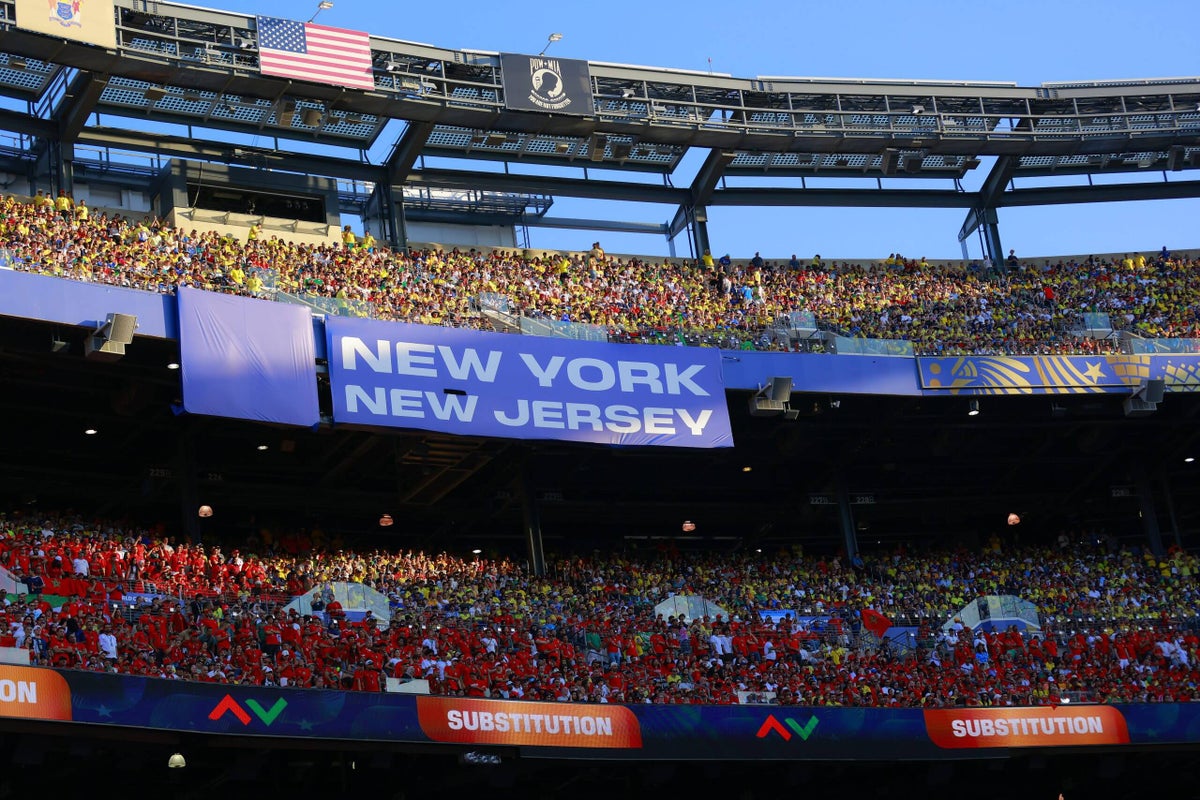
At 9pm on Saturday, shortly after the final whistle blew on Morocco against Brazil at MetLife Stadium, four individuals posed for a photograph.
The New York City mayor Zohran Mamdani, beaming in the middle, stood alongside Kathy Hochul and Mikie Sherrill, the governors of New York and New Jersey. Completing the set was Alex Lasry, chief executive of the joint New York New Jersey World Cup host committee, tasked with organizing the logistics and operations for eight World Cup games taking place in the region this summer.
The smiles betrayed genuine tensions and performative subplots which dominated recent months.
Take, for example, the $98 round-trip rail ticket to travel to MetLife Stadium via New Jersey Transit — up more than seven times its usual price. The dispute over the new, FIFA-approved name for the venue during the World Cup — officially New York New Jersey stadium. An official request by New Jersey governor Sherrill for one of two major signs at the stadium to read “New Jersey New York”.
Or the flurry of announcements over ticket allocations: first, Mamdani announced 1,000 $50 tickets (the cheapest on sale at the tournament) to be awarded via a lottery for New York residents. Then some New Jersey politicians, according to numerous sources, requested 1,001 tickets for New Jerseyans — taking oneupmanship to its literal definition. In the end, they made do with 770 but these were free, rather than $50.
Just wrapped up an incredible first game here in Jersey! pic.twitter.com/g0T8Z7fTpH
— Governor Mikie Sherrill (@GovSherrillNJ) June 14, 2026
Mike Inganamort, a Republican member of the New Jersey general assembly, tells The Athletic. “The game is in New Jersey… If I host a barbecue and my neighbor attends, we don’t both get credit for hosting the barbecue.”
Collectively, New York and New Jersey have poured hundreds of millions of dollars into this World Cup. Between New York City and New York state, the host committee has received $61 million, as first reported by Politico, and New Jersey has put in $50m — $15m of which was a loan from the New Jersey Sports and Exposition Authority.
The states have also spent millions marketing themselves around the World Cup, while they jointly received over $66 million in federal security funding. New Jersey also spent more than $37m on improvements to MetLife Stadium, while $40m has been spent — with $13.2m in federal assistance — for a new pedestrian walkway near MetLife. A further $40m has been budgeted for New Jersey agency costs which may emerge this summer.
The calculus, with all of this, is that the spending will be recovered in the estimated $3.3 billion worth of economic impact, although such studies are often treated with caution.
Saturday brought the first major test of how well New York and New Jersey could work together, as they sought to transport a sell-out crowd of over 80,000 to and from the stadium. In colliding with a spontaneous breakout of people on the streets in Manhattan, as a city celebrated the New York Knicks’ first NBA championship since 1973, this was always going to be a unforgiving evening for organizers.
The match ended shortly before 8.30pm and the Knicks sealed victory at around 11.30pm but the city had started to fill up, and have roads blocked off, long before that. In the early hours, it became destructive, with nine of the yellow school buses hired to transport fans to and from the World Cup game abandoned by drivers and passengers. Five of the buses were destroyed altogether. One was set on fire.

People climbed on buses as they celebrated the Knicks’ win ( Adam Gray / Getty Images)
Over recent weeks, The Athletic has held dozens of conversations with those intimately involved in the planning of the tournament in the region. Here, we detail some of the blemishes that pockmarked the opening night, the squabbles that dominated the build-up to the World Cup and why changes of leadership in key political positions posed a challenge for preparations.
Host committee CEO Lasry told The Athletic: “The rivalry is part of the fun. It is a great encapsulation of sports; rivalry but no real hatred. We can talk about each other, but no one else can talk bad about us. Sibling rivalry. Everyone’s having more fun with it than people are giving them credit for.”
New York New Jersey: Why does the partnership exist?
The first pitch to FIFA came in 2017, during Phil Murphy’s first year in office as New Jersey governor. He and his wife Tammy jointly addressed a FIFA delegation at the New York Red Bulls’ stadium in Harrison, New Jersey. The 25,000-seater venue was chosen for the meeting as it had been opened in 2010; a shinier and more intimate setting than the cavernous MetLife stadium, even though the latter was always going to be the stadium used in the tournament.
The Murphys are soccer enthusiasts, founding owners of NWSL side Gotham FC, and they believed in the economic bet of a World Cup; a chance to renew New Jersey as a sporting hub.
They also saw a natural partnership with New York City. The view back in 2017 was that New Jersey had the stadium, the training bases and the soccer relationships, while the involvement of New York City would bring the glamour, the global prestige and picture-perfect landmarks. “We know from the start we could not win this without New York City,” said one person intimately involved in the planning, speaking on condition of anonymity like others in this piece because they were not authorized to speak publicly.

Then-Jersey Governor Phil Murphy speaks at New York New Jersey’s launch ceremony in May 2023 (Liu Yanan/Xinhua via Getty Images)
Multiple people said that no clear agreement was ever signed between New York City and New Jersey to ensure parity in the costs of the preparations, but one said it was assumed that it would be a 50-50 partnership. Over several years, the Murphys, in partnership first with New York mayor Bill De Blasio and then with Eric Adams, charmed FIFA president Gianni Infantino, holding a series of coffees, dinner and Zoom calls. Hochul joined one particularly significant lunch with Infantino at the Plaza Hotel near Central Park, alongside NFL team owners and regional business executives.
Before being awarded the final, another lunch was held, this time in the Equinox Hotel at Hudson Yards. Jared Kushner, the New Jerseyan son-in-law of President Trump and a close friend of Infantino, helped convene a who’s who of regional CEOs and deal-makers to woo the FIFA president. Kathryn Wilde, one of New York’s most famous conduits to the super-rich and former leader of the Partnership for New York City, also played a key role. The lunch was in Manhattan, but deliberately overlooked the Hudson River, providing views of Jersey in the distance.
The organizers racked their brains. They studied how logistics had been organized when Taylor Swift came to town and when the Pope visited. They scrutinized the failure of the Super Bowl at MetLife in 2014, when transportation chaos left some fans exasperated. They provided FIFA with estimates of the chances of thunderstorms in mid-July, and, crucially for FIFA, whether seats could be covered for VIPs. The charm offensive worked: MetLife received eight games — including the final.
So, what changed?
In New Jersey, Murphy exited office in January, replaced by Sherrill. In New York City, Adams was replaced as mayor by Mamdani. In New York State, Gov. Hochul is vying for re-election in November and is preparing a Winter Olympics bid for 2042, so a World Cup provides a strong proving ground. All three are Democrats, but they have been simultaneously in partnership, while also in competition for headlines.
Sherrill has been the most charged, attempting to pull back on her state’s spending. Almost immediately, she cancelled the official FIFA Fan Fest in Liberty State Park. A clear reason was never provided, but sources say this was driven by costs and a desire to give greater value to the taxpayer.
Then, she directed NJ Transit to set a price for rail tickets — usually $12.90 — for World Cup games, which would prevent costs to be directed towards her own taxpayers. This led to a $150 price tag, before support from sponsors reduced the cost to $98. FIFA accused the governor of having a “chilling” effect on the World Cup.
She and Infantino have not met in person since. Sherrill was due to visit the FIFA suite at the game on Saturday, but Infantino instead attended games between Qatar and Switzerland, and then Australia and Turkey.

Brazil and Morocco met in the first 2026 World Cup game at MetLife Stadium (tephen Nadler / ISI Photos via Getty Images)
Infantino retains a warm relationship with her predecessor Murphy, who saw him both at the opening of the Azteca Stadium in Mexico City in spring and more recently at the Miami birthday party of Carlos Cordeiro, the former U.S. Soccer president who is now Infantino’s consigliere in the United States.
Sherrill publicly argued that FIFA, with their $11 billion World Cup revenue, ought to assist cities with the costs of public transportation, transit hubs and public safety but FIFA’s view is that stars such as Taylor Swift or Bruce Springsteen would never be asked to help subsidize fan travel to their concerts. Four people familiar with the plans say that Sherrill’s direction on NJ Transit pricing marked a break from prior expectations under Murphy, where it had been assumed there may be a much smaller increase or prices would have been kept the same.
Sherrill has, however, welcomed Brazil, Haiti, Senegal and Morocco to their bases in New Jersey and approved $5m to fund watch parties, fan zones, and street festivals. Two sources say her office requested that she do the coin toss at one World Cup game, which is usually reserved for the match-day referee. A state official declined to comment.
One person close to the planning said: “Mikie is just fighting for New Jersey. The operational burden is more on New Jersey. New York does get to have a little bit more fun. She is saying: ‘I’m not going to let New Jersey be on the hook for everyone having fun in New York City.’”
Lasry said: “New Jersey has a feeling of ‘If we’re splitting the games, why are all the operational costs on us?’ I would probably disagree that’s the case. But that’s also what happens when you have the stadium.”
The battle for tickets
Soccer-mad mayor Mamdani certainly seems to be enjoying his summer of sport, announcing a watch party in Central Park and a tie-up with restaurants to provide $26 meals during the World Cup across New York City’s five boroughs.
He was also first out of the traps on tickets, negotiating directly with Infantino to secure 1,000 $50 tickets for New York residents. Sherrill’s office was unhappy with the host committee and FIFA, who had approved the move, with a spokesperson saying: “FIFA not caring about costs for New Jersey residents isn’t new.” However, several sources said her office had known ahead of time about Mamdani’s efforts, but at that stage, her focus was, not unreasonably, on securing $3.6 million from the host committee to fund discounted tickets for NJ Transit riders whose commutes are impacted by the World Cup games.

Zohran Mamdani and Kathy Hochul at the Puerto Rican Day Parade 2026 on Fifth Avenue, Manhattan on Sunday. (Jose Perez / Bauer-Griffin/GC Images)
Suddenly, this was not only New Jersey vs. New York, but also New Jersey fighting against itself, with Sherrill clearly unimpressed by her inheritance.
Republican members of the New Jersey assembly wrote to Lasry and Phil Murphy’s wife Tammy, who remains chair of the host committee board, requesting a detailed explanation of how New Jersey’s money has been spent.
Lasry says the committee, which hired six sales staff to raise funds through partnerships, is on track to break even during the tournament and is hoping to secure more partnerships than any other host region, having been allowed by FIFA to have 20 partners rather than 10 due to two states being involved.
In the week before the World Cup, New Jersey got its wish, securing 770 tickets — for free — which would be donated to local youth soccer teams, families of New Jersey National Guard service members, and Bergen County first responders who are aiding World Cup operations, among other good causes.
Hochul, too, would get her own moment in the sun; receiving 500 tickets to be given to military families and first responders.
Republican Inganamort tells The Athletic: “It is hard for me to get excited about the World Cup in New Jersey, when so much of the excitement and spotlight has been consumed by New York. For decades, New York has outshone New Jersey in various sporting events down to the professional football and soccer teams which play in New Jersey and carry the New York name. New Jersey comes to this with a chip on its shoulder to begin with. The World Cup, played at New York New Jersey Stadium, organized by the New York New Jersey host committee… each one is a little dig at New Jersey.”
$98 trains and yellow school buses…
If there has been a sincere tension, it has been over the pace of sales for the two public transit services being provided by New York and New Jersey to MetLife Stadium.
Following a backlash against the initial $150 price of the NJ Transit train, Hochul, Mamdani and the host committee worked together to expand their shuttle bus service, which had initially been priced at $80.
This was supposed to carry 10,000 supporters but, following a $6 million investment from Hochul’s state funds, this service was reduced from $80 to a $20 round trip and included hiring 150 yellow school buses on non-school days to increase the affordable travel options available to World Cup match-goers. It will increase to 12,000 on schooldays and 18,000 on non-schooldays.
This appeared to be perceived by some in New Jersey as a challenge to its captive market. NJ Transit reduced its price, too, to $98 tickets to cover its operations, estimated at $4m per game, after sponsors offered support.
When NJ Transit reduced its pricing to $98, its partners in New York were not aware until the news broke on The Athletic.
In a transportation briefing presented in May, it was forecast that 40,000 fans would travel by the rail service but, on Saturday night, this did not materialize.
According to NJ Transit’s numbers, only 21,578 fans bought a $98 ticket for Brazil against Morocco on Saturday night, which would suggest that the agency did not come close to covering the cost of its operations.
The Athletic asked NJ Transit if it will now bring down the $98 price in an attempt to recover more of its expenditure, but received no comment. Some travellers posted photographs on trains that looked extremely sparse, but the trains themselves functioned well. NJ Transit wrote on Twitter that Gov. Sherrill deserved “credit for developing and implementing a plan with contingencies.”
NJ Transit sources insisted on Sunday evening that the $98 ticket costs were not responsible for people traveling by other means.
Around 16,013 travelled via the bus service, which had availability up to 18,000. On the way to the game, the service operated smoothly, ensuring that all fans who traveled via the service arrived on time for the game, even if there was some usual match-day traffic en route.
After the game, it was more fraught, with the journey to enter Manhattan taking around two hours and buses crawling towards their destinations during the latter stages of the Knicks game. Nine buses were abandoned during the raucous celebrations, with five buses set on fire or destroyed by vandalism or trampling, which the host committee said was “unacceptable.” No passengers or drivers were injured.

New York Knicks fans climb on buses hired to ferry supporters to the earlier World Cup game at MetLife Stadium (Adam Gray / Getty Images)
The combined travel between the train and the bus, therefore, came in at just over 37,000, meaning over 50 percent of the 80,000-capacity crowd did not use public transport at all. NJ Transit sources also suggested on Sunday that people were taken away from public transit because more parking spaces than initially expected were made available at the American Dream mall close to MetLife, where around 4,000 cars ended up parking on the day.
Lasry has said he has always told his team that judgment will be made based on what the headlines say on June 14, the day after the opener, and July 20, after the final.
June 14 could be filed under ‘must do better’, and review calls were held on Sunday, but even critics would concede that the task was made more difficult by the timing of the Knicks’ success. The final, which kicks off at 3pm local time, will bring similar challenges on a lesser scale: on July 19, Bon Jovi will play at Madison Square Garden, Ariana Grande will play at Barclays Center and the New York Yankees will play the Los Angeles Dodgers.
“We can do it all,” Lasry said, speaking last week. “That’s part of the pride of New York.
“We’ve had to navigate three or four governments, transitional governments and elections. But I do think everyone’s going to say at the end: yes, that was awesome.”
