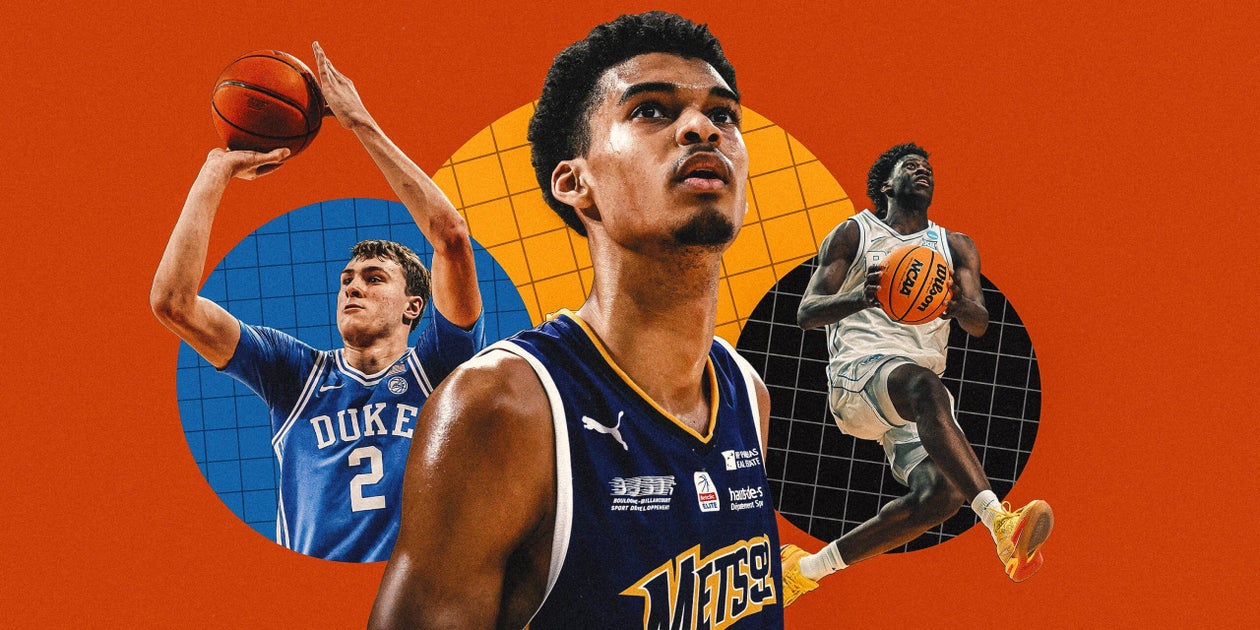
I’ve been evaluating NBA Draft prospects professionally for more than a decade, first at CBS Sports and now at The Athletic. So let’s re-heat a project I did last season, assessing where the best prospects in the 2026 NBA Draft would rank if I were slotting them compared to every other draftee I’ve evaluated since 2015.
How strong is the top end of the 2026 class? Four players who will be drafted later this month are listed within my top-20 prospects. However, none of those players are inside the top five, which also reflects conversations I’ve had with NBA executives about whether there is truly a No. 1 player on a title team in this class.
Still, teams and fans of teams with top-four picks in this draft should be absolutely thrilled, as they’re locked into getting an elite prospect.
A few notes:
• The players who fell off last year’s list to make way for the new four? Brandon Ingram, LaMelo Ball, Jabari Smith Jr. and Paolo Banchero.
• The highest-graded players on my board who didn’t make the previous list? Jahlil Okafor, D’Angelo Russell, James Wiseman, Anthony Edwards, Jalen Green and R.J. Barrett. The big miss is obviously Edwards, who went No. 1 in 2020. I was too skeptical of his ability to consistently create rim pressure and paint touches, as he often settled for pull-up jumpers.
• There are only two drafts not represented here. The most recent one is 2024, which featured zero Tier One or Tier Two players. No player in that class would have even rated within my top-35 prospects of the decade. The 2020 class is also not featured with Ball falling off. That makes sense looking back, as that class featured an immense level of uncertainty given the pandemic. But with Ball, Edwards, Deni Avdija, Tyrese Haliburton and Tyrese Maxey emerging as franchise players, it’s clear I undervalued that class.
• This list is based solely upon how I graded these players as prospects when they entered the draft, not how they played as pros.
1. Victor Wembanyama | 7-4 center | Metropolitans 92 | 2023
Wembanyama is the clear No. 1 prospect, because we had never seen a player like this before. That’s not to say that truly special talents like Kareem Abdul-Jabbar (then Lew Alcindor), Ralph Sampson, Shaquille O’Neal and LeBron James weren’t as impressive; rather, we’d never seen a 7-foot-4 human who could dribble, pass and shoot at this level as a teenager. Maybe if Sampson and Abdul-Jabbar had been born in this era, they would have developed those skills.
But Wembanyama was entirely novel. Essentially, he projected to be Rudy Gobert-like on defense while also being a legitimate shot creator and shot-maker on offense. It’s a truly absurd combination of skills.
Wembanyama is the highest-upside prospect to enter the NBA since LeBron, and his performance through his first three years in the NBA has only put an exclamation mark on his game. All he’s done is lead the San Antonio Spurs to the NBA Finals before the end of his rookie-scale contract while finishing third in MVP voting, winning the Defensive Player of the Year award and being named First Team All-NBA.
I don’t think we’ll see a prospect like Wembanyama again in quite some time.
2. Cooper Flagg | 6-8 wing | Duke | 2025
Flagg and the next guy on this list are the clear contenders for the No. 2 spot. Flagg is safer when it comes to health, as he’s never suffered a major injury.
Flagg led Duke to a Final Four, an ACC title and a 35-4 record as a freshman. On offense, he became a highly skilled mismatch nightmare who could bully smaller players by backing them down, shooting over the top of them or posting up. Or he could hammer bigger players by getting off-balance, and either going around them to the rim or hitting a stepback. When defenders collapsed onto him, he always made the right reads. And then on defense, he was a force in help all season and competed on the ball at a high level. It wouldn’t stun anyone if he makes an All-Defensive team at some point.
He’s also one of the most competitive, winning-focused teenagers to enter the NBA in a long time. He wants to be great, but he does whatever it takes for the team to win. He plays hard all the time and is relentless in his aggression on both ends. He gives energy to his teammates and is all sorts of tough and fearless. He’s the easiest person to buy into becoming a winning basketball player because he amplifies those around him. Outside of Wembanyama, Flagg has the best combination of a ridiculously high floor and also a ridiculously high ceiling if everything goes right in his development. He has a chance to become the next apex wing in the NBA.
Flagg won Rookie of the Year this season with the Dallas Mavericks, averaging 21 points, 6.7 rebounds and 4.5 assists. He looks like a future superstar.
3. Zion Williamson | 6-6 wing | Duke | 2019
When Williamson played at Duke, he had the best blend of power and explosiveness I’ve ever seen on a basketball court. Built more like an elite defensive end than a traditional basketball player, Williamson waddled around between plays but was an undeniable force once the game began. The way he leaped with force but then hung in the air like he was levitating is still a unique viewing experience.
He was sudden with his movements as a ballhandler, freezing defenders with nasty inside-out moves before pulling up from the midrange. He was more comfortable shooting from distance then than he is now. His ability to pressure the rim was unique then and has translated to the NBA when he’s been on the court.
Alas, the injury concerns were there before the draft with Williamson. He suffered a foot injury in high school, a thumb injury at the McDonald’s All-American game, a minor knee injury in the spring of 2017 and a right knee sprain at Duke. While Williamson was remarkably skilled for his size, there were worries he would lose some of his elite explosiveness as he aged.
Still, Williamson’s upside at the time was seen as potentially the best player in the NBA. He’s clearly the No. 3 player here.

Cade Cunningham has fulfilled his potential with the Detroit Pistons. (Ken Blaze / Imagn Images)
4. Cade Cunningham | 6-6 guard | Oklahoma State | 2021
I was higher on Cunningham than many entering the 2021 NBA Draft. I had him as my lone Tier 1 player in that class largely because of how he created shots for both himself and his teammates. Going back to his final year at Montverde (Fla.) Academy, Cunningham possessed a unique ability to control the game at a high level. He and Luka Dončić are likely the two most polished ball-screen creators to enter the league in a long while; both have enormous frames that allow them to maintain advantages in drop-coverage situations with defenders trailing, or in switch situations where they would get matched up against smaller players in guard-to-guard actions.
In both high school and college, Cunningham showed he could hit every passing read off a live dribble with either hand, something that has translated nicely to the NBA, given that he averaged 9.9 assists per game this season for the Detroit Pistons.
Cunningham’s ability to separate in isolation was questionable because he wasn’t all that fast. Defensively, he was OK, not great. Cunningham was also a turnover machine at Oklahoma State, averaging four per game. That hasn’t changed in the NBA. And yet, it didn’t worry me enough to think that Cunningham wouldn’t be a tremendous, All-NBA caliber talent. And that has played out over his rookie-scale deal.
Troy Weaver, the former Pistons’ general manager, did a catastrophic job of building around Cunningham for three years before the team fired him and hired Trajan Langdon. After a summer of focusing on shooting, Cunningham made Third Team All-NBA in his fourth season. Then he led Detroit to the No. 1 seed in the Eastern Conference in his fifth season, earning First Team All-NBA status. Yeah, he’s turned out just fine.
5. Karl-Anthony Towns | 6-11 big | Kentucky | 2015
Towns was a part of what is still the best college basketball team I have watched in recent memory: the dominant, platoon-based, 38-1 Kentucky Wildcats who ran the table before losing to Wisconsin in the 2015 Final Four. Towns in the middle was the key to all of it.
His college numbers looked relatively pedestrian: 10.3 points, 6.7 rebounds and 2.3 blocks. But he did that in just 21.1 minutes per game while playing on a laughably loaded team where no one averaged more than 11 points. He was wildly efficient as a post player with clearly elite touch, and everyone who saw him in high school knew he could shoot even though he made only two 3s during his collegiate season. He looked like a mismatch nightmare with his ability to dribble, pass and shoot at 7 feet tall. His defense looked like the easiest translatable skill. He swatted shots with impunity, finishing top 20 in the country in block rate. He rebounded well and was used in a variety of ball-screen coverages effectively.
His pro career has gone differently, even though he has made three All-NBA teams. Towns has become arguably the best 7-foot shooter at the center position in league history. He’s a career 39.7 percent 3-point shooter on 3,097 career attempts, won the 3-point contest at All-Star Weekend in 2022 and will enter the top 100 all-time in 3-point makes next season. On defense, Towns turned into a difficult player to build around early in his career but he has drastically changed the perception of his career during the Knicks’ run to the NBA Finals this year. He’s done a great job defensively and showcased serious toughness in all aspects of his game.
6. AJ Dybantsa | 6-9 wing | BYU | 2026
Dybantsa has long been seen as a potential No. 1 pick, and as a freshman at BYU he averaged 25.5 points while shooting 51 percent from the field, 33 percent from 3 and 77.4 percent from the line. You can count the number of players who matched those marks on two fingers. He has better physical tools than any wing I’ve seen in a while. His ability to play with elite bend mixed with explosiveness allows him to consistently get into the teeth of the defense as a straight-line driver. In transition, he’s an absolute menace. His nose for the foul line is second to none.
He has all of the tools to become an apex wing shot creator in the league, but he’ll need to iron out some parts of his game. That’s why he’s ranked sixth here. First, he needs to improve as a shooter from distance. His midrange game is strong, but he can lean on that too aggressively sometimes. He’s a good passer, but he will occasionally miss passing reads. Defensively, Dybantsa is a good, switchable on-ball defender but has moments of not disrupting the game as well as you’d expect.
Still, Dybantsa is a special prospect, and one who projects exceptionally well in the NBA because of how effective he is at creating rim pressure, in addition to his improved shooting. It’s not impossible that he could average 30 points per game at some point.
7. Cameron Boozer | 6-8 forward | Duke | 2026
Since he was a freshman in high school, Boozer has been the most productive player in his age group while continually expanding his game, turning into one of the most versatile offensive chess pieces we’ve seen enter the draft in a while. At Duke, Boozer shot 55.6 percent from the field, 39.1 percent from 3 and 78.9 percent from the line en route to winning national player of the year honors. Per Sports-Reference, Boozer became the first player (regardless of class) to average 22, 10 and 4 while shooting 55 percent from the field and playing at least 20 games. Boozer is a metronome. You know what you’re getting every night from him. He’s pretty close to a can’t-fail offensive prospect.
The questions surrounding Boozer come on the defensive end. He was a tough, physical defender at Duke, and he constantly communicates and calls out coverages to his teammates. But the odds are high that teams will take advantage of Boozer defensively, even though he’s a sharp processor. He is undersized for the center position, given his lack of vertical leaping ability. But then at the four, if a team has a perimeter-based player, he might have a hard time chasing around screens regularly given his bulky frame, and he’ll likely be asked to switch more consistently playing the four than he would otherwise.
But this is as simple as betting on a nearly complete offensive prospect and living with the tradeoffs. He is one of the quickest processors on a basketball court that I’ve ever seen.
8. Darryn Peterson | 6-5 guard | Kansas | 2026
Peterson ranks in the top 10 for a couple of reasons. First, he was as complete a guard as I’ve evaluated entering college basketball in a long time. He’s an aggressive shot hunter, and I love the way that he went about improving his passing ability out of ball screens. Until this season at Kansas, he had never stagnated, continually working his way up a steady trajectory to the top of his recruiting class. He performed better than every elite prospect in the class regularly when they faced off in showcase matchups. And at Kansas this year, he averaged 20 points in 29 minutes per game and looked like the elite scorer he has the potential to be in the NBA, despite dealing with significant cramping issues and a hamstring injury early in the year.
Alas, those issues created some bizarre moments for Peterson, as he would dominate first halves and not return after halftime. If Peterson had played more full games at 100 percent, I think there is a strong chance he would be ranked somewhere in the top five of this list. However, his injuries and issues have led to questions for scouts. He didn’t consistently get to the rim this year — both because of his injuries and a roster around him that featured essentially zero shooting. His passing ability that showed up in his later high school career didn’t pop up regularly this year, as he played much more off the ball.
Peterson is an elite prospect but one with questions, which is why he slots in around the middle portion of this list.
9. Ben Simmons | 6-10 guard | LSU | 2016
Simmons’ career is the kind that they make YouTube videos about, especially after it went so well in his first four NBA seasons.
Simmons was utterly dominant at LSU, a 6-foot-10 transition dynamo who was athletically superior to everyone around him. He averaged 19 points, 12 rebounds and five assists as LSU played at a breakneck pace to accentuate his gifts. He would grab-and-go on the break to lead the offense and had a sublime blend of power and coordination to dribble and read the court simultaneously. He could get to the rim with ease and would finish well above it with regularity. Guys aren’t supposed to move like Simmons did at his size. He was a walking paint touch who would throw in wild Euro step moves to cause the defense to collapse or to open up a lane to the rim before finishing or kicking out to his teammates. He could make every pass in the book.
And yet, Simmons could showcase a laissez-faire attitude on defense. He had all of the tools to be great but didn’t always use them. He didn’t always take control of the game and had nights when he looked like he was just hanging out before getting to the NBA. Many pre-draft reports also questioned his attitude.
After sitting out his first pro season with a broken right foot, Simmons averaged 15.8 points, 8.1 rebounds and 8.2 assists as a rookie for the Philadelphia 76ers. He made the All-Star team in his second season, and earned Third Team All-NBA honors his third season. Then in 2020-21, he was second in Defensive Player of the Year voting and got an MVP vote. However, he struggled immensely that postseason, culminating in a Game 7 moment in the second round against the Atlanta Hawks when he passed up a wide-open dunk. Things became a disaster after that, and he last played an NBA game in April 2025.
A combination of the concerns that always surrounded Simmons mixed with injuries tanked a once-promising career. In retrospect, Simmons probably should not have been as highly regarded as he was, and yet it’s clear that it never had anything to do with his talent.
10. Markelle Fultz | 6-5 guard | Washington | 2017
Speaking of strange careers, Fultz’s is probably the most bizarre of any player on this list.
It’s hard to overemphasize how creative and special a prospect Fultz was at Washington. He averaged 23 points, six rebounds and six assists per game while mixing in 1.6 steals and 1.2 blocks. He displayed tremendous passing vision, with the ability to execute reads from a variety of different angles with his near-7-foot wingspan. Every indicator projected him turning into an elite 3-level scorer.
Fultz also had special creativity and tempo. His handle was tight and crisp, with serious hesitation and craft with his footwork. He could gather into a shot at the rim from a variety of different angles. His crossovers were nasty and sudden. This should have worked.
But then a shoulder issue, mixed with changes to the mechanics of his jumper before he reached the NBA, sapped his shooting ability. At first, his shoulder problem was diagnosed as soreness and a scapular muscle imbalance. But the following season, Fultz was diagnosed with thoracic outlet syndrome.
Fultz never recovered his shooting ability. He has never attempted more than 1.9 3-pointers per game in the NBA. He has stuck around the league and earned a three-year, $50 million contract extension with the Orlando Magic after being traded by the 76ers. It’s hard for me to blame this one on evaluators getting it wrong. Fultz got hurt before we got to see his best in the NBA.
11. Ja Morant | 6-2 guard | Murray State | 2019
Morant was overshadowed by Williamson during his pre-draft year but was a special prospect in his own right. A true under-the-radar recruit, he wound up at Murray State, where he exploded as a sophomore, averaging 24.5 points, 10 assists, 5.7 rebounds, 1.8 steals and 0.8 blocks. He dominated every game with mind-bending athleticism in transition and a brain that innately saw passing angles all over the court. Moreover, he was dynamic with the ball in his hands, a genuine blur who could change directions and speed, or merely just beat his man to get an easy paint touch.
Sometimes, you need to dig deep into stats and put all sorts of filters on them to find the diamonds in the rough. In Morant’s case, you can simply say this: He’s the only player in the last 65 years of college basketball, per Sports-Reference.com, to average at least 24 points and 10 assists per game in a season. Morant has been an All-NBA player, although he has missed a lot of time during the last few years with injuries and a suspension stemming from firearm-related incidents. It is concerning that he has yet to play more than 67 games in a season and has played a total of 79 games in his last three seasons.
Morant’s time in Memphis seems to be coming to an end; we’ll see if he can get his career back on track elsewhere.
12. Deandre Ayton | 7-0 center | Arizona | 2018
In hindsight, I screwed this one up. I loved Dončić and had a higher grade on him than the NBA consensus when he entered the league, but having Ayton at No. 1 that year was too aggressive. Why was he so highly thought of? I’m not sure that any player in college basketball over the last decade has looked the part more than Ayton did in 2018, and I was still in a phase when I thought that mattered more than it does. He is over 7 feet tall, with a massive 7-foot-6 wingspan and as chiseled a 250-pound frame as you’ll find.
In his lone year at Arizona, Ayton averaged 20 points and 11 rebounds while shooting 61 percent from the field and made a dozen 3s. He was a first-team All-American and the Pac-12 Player of the Year. Ayton’s post game was excellent, he had potential as a rim-runner in ball screens and his physicality was so next-level at 19 years old that he looked like he could bully even NBA guys at his ceiling. There were some incredibly lofty Patrick Ewing-ish outcomes if he reached his ceiling.
Alas, I undervalued how far behind he was with his ball skills and passing ability. I also missed that he rarely played with any bend, which allowed the opposition to leverage him regularly. Ayton has had a solid career as a key piece of a Phoenix Suns team that made the NBA Finals. He was eventually traded to the Portland Trail Blazers and now plays for the Lakers where he had some positive moments this season. But this is the first one here that is an outright miss, given that I had him below Dončić, even if that was a consensus take at the time.
13. Luka Dončić | 6-8 guard | Real Madrid | 2018
Dončić’s dominance was unparalleled in European basketball at his age. I wrote extensively about this at the time and loved Dončić’s game, ranking him essentially as the 1B in his class to Ayton’s 1A. He won Euroleague MVP at 19 and had already proven himself as a true pick-and-roll savant at 6-foot-8. It’s not unfair to call Dončić’s resume the most decorated one among all teenage basketball players of the last 25 years.
So why in the world was he not the consensus No. 1 pick? I fell victim to this less than most, but it was an industry-wide lack of comfort at the time with projecting players from Europe. Only two European players without collegiate experience had been selected in the top two picks in the draft. Their names live in mononymous infamy: Darko and Bargnani. But Darko Milicic averaged under 10 points per game in Serbia. Andrea Bargnani was better playing for Baskonia in Euroleague but averaged just 9.9 points and two rebounds. Most of the other young European top-five picks weren’t that successful in the NBA. However, none of those players were nearly as accomplished as Dončić. Only Pau Gasol, who won second-team All-Euroleague honors at 19 in 2001, could approximate it.
Dončić’s frame led many to question his upside long-term — which is how he ended up going No. 3 — as he wasn’t all that explosive. But he was immensely skilled and saw the court at an elite level. He has a special basketball mind, processing things around him unlike anyone else. Dončić should have been universally recognized as a LeBron-like prospect. If he came up in today’s basketball ecosystem, I think he would clearly be seen as such. It just wasn’t the case at the time.
While I just liked Ayton too much as opposed to undervaluing Dončić, I underrated his upside. I thought he was likely to be an All-Star/All-NBA player as opposed to a top-five player in the league.
14. Scoot Henderson | 6-2 guard | G League Ignite | 2023
I misevaluated Henderson by grading him out as more athletic than he actually is. The reason was a lack of understanding (not just from me, but from many across the basketball industry) of how teenagers’ performance in the G League translated to the NBA. At 18, he averaged 18 points, five rebounds and six assists in that league, playing against men fighting for their NBA lives.
At his best, Henderson changed tempo and pace at an exceedingly high level and had a handle that allowed him to navigate tight areas. He also blended power with a low center of gravity and physicality to maintain advantages. That made him very well-rounded in ball-screen actions. He could pull up and hit floaters, get to the rim and finish with authority or touch, or he could make high-level passing reads. And he always drove transition play with his aggressiveness.
But I thought he would get more paint touches than he has so far in his career. His rookie season was poor, as he couldn’t get into the areas of the court he needed and seemed to struggle to read where help defenses were playing him. He showed positive flashes in his second season. His true-shooting percentage compared to the league average jumped by 10 percentage points. He found more consistent answers as a pull-up shooter and turned the ball over less often.
This past season, Henderson dealt with a torn left hamstring that held him out of Portland’s first 51 games. However, once he returned, he looked good. He averaged 14.2 points, 2.7 rebounds and 3.7 assists in 25 minutes per game, then was excellent in Portland’s first three playoff games against San Antonio. He averaged 15 points per game for the series while shooting at 48/46/75 splits, and there should be some excitement about Henderson entering a critical fourth year.
15. Jayson Tatum | 6-8 wing | Duke | 2017
After a few losses, I’ll happily note that I was higher on Tatum than the consensus in 2017, ranking him as my No. 2 player in the class behind Fultz. I loved his game and thought the smoothness of his repertoire would translate. Tatum was a polished scorer at Duke, averaging 17 points, seven rebounds and two assists, but it was more about the way that he got better throughout the season that impressed me.
Tatum’s footwork into his gathers was elite and showcased serious potential. His jab-step game was filthy out of triple-threat situations, and his mid-post game was already incredibly developed for a teenager. His balance was superb and allowed him to find different stepback jumpers with a smoothness beyond his years. His passing vision was tremendous for the role, though he consistently turned the ball over on his slashes toward the rim. Tatum was a great bet to continue to improve, as he came from a basketball family (his father Justin played at Saint Louis and is a coach) and was known to have an elite work ethic and habits.
Whereas nearly every team had Fultz as the top player, the Boston Celtics had Tatum atop their board, traded out of the No. 1 pick with the 76ers down to No. 3 and still got their guy. Tatum was the best player on a title team, a five-time All-NBA selection and has positioned himself as one of the greatest Celtics in the storied franchise’s history.
16. Chet Holmgren | 7-0 big | Gonzaga | 2022
Holmgren was my top player in the 2022 NBA Draft, and I would have had a Tier One grade on him if not for his frame. Weighing in at just 195 pounds coming out of Gonzaga, Holmgren had to prove he could withstand the wear and tear of the NBA. But Holmgren has always been one of the most competitive players you’ll watch. I loved his game and saw him as the guy I wanted most in that class.
He was a unique player, and one of the best defenders I’d evaluated at his age. He was already positionally elite and had every length-based tool at 7 feet with a 7-foot-6 wingspan. His anticipation and instincts were outlandish, and he’d make some of the most incredible scramble rotations to help his teammates I’d seen at that age. I predicted that “if his frame allows it, he is going to win at least one Defensive Player of the Year award.” He’s one of the five best defenders in the NBA right now with the versatile nature of his defense in ball screens, his ability to scramble and help his teammates and his rim protection. He constantly cuts off angles and makes life miserable for the opposition. He can also handle the ball at his size and take opposing centers off the dribble, in addition to knocking down shots from distance.
Last year when I did this ranking, I predicted that Holmgren would make at least one All-NBA team in his career. That occurred this season, and he’s the first in his draft class to do so. Some playoff issues against Wembanyama popped up, but Holmgren looks like he’s going to be among the NBA’s elite two-way players for quite a while.
17. Dylan Harper | 6-5 guard | Rutgers | 2025
The second player from the 2025 NBA Draft behind Flagg, Harper looked like he had a tremendous chance to become an All-Star point guard. He ticked nearly every box. He has great size and length for the position at 6 feet 5 with long arms. He created rim pressure at an elite level at Rutgers, despite playing in an archaic offense that lacked spacing. He drew fouls regularly and has showcased vision throughout his career, both for the Scarlet Knights and for USA Basketball. He’s competitive on defense and tough. The only cause for concern was that he needs to keep working through his pull-up game, and that’s ultimately what slotted him more in this bucket as opposed to within the top 10.
As a rookie, Harper proved that he’s going to be among the game’s elite guards. He’s been a critical part of the Spurs’ run to the finals, averaging 13.6 points, 5.6 rebounds and 2.6 assists while shooting 41 percent from the field in the postseason and looking like he’s ready to explode into being a star as soon as next season. Few rookie guards in league history have been as good in high-leverage moments as Harper has this postseason. He looks like the No. 2 next to Wembanyama, and they’re both on rookie-scale contracts.
18. Caleb Wilson | 6-9 forward | North Carolina | 2026
Wilson was wildly explosive and productive this season at North Carolina, dominating games with his athleticism, motor and ability to create shots both in transition and in the mid-post. He averaged 19.8 points, 9.4 rebounds and 2.7 assists while shooting 57.8 percent from the field. No player to average those numbers has also shot that well from the field as a freshman. North Carolina essentially played him as if he were a mini-Giannis this year in its scheme before he broke his thumb in February, an injury that ended his (and essentially the Tar Heels’) season.
But his skill level is lower than some of the guys ahead of him, and he has less polish to his game. His touch on layups was suspect this season, his handle needs to continue improving and he’s still not comfortable taking and making 3s. Defensively, he can make impact plays, but his possession-by-possession impact was not as strong as you would like. His ceiling is close to as high as the 2026 players ranked above him, but the floor is lower. Still, the Chicago Bulls at No. 4 should be thrilled that they’re getting a player that I would rate as being commensurate with the No. 2 pick in a normal class.
19. Jalen Suggs | 6-4 guard | Gonzaga | 2021
I loved Suggs pre-draft, and I remain a big fan of his game. He made an All-Defensive team on his rookie contract, and I’d expect him to make a few more. But I was too aggressive ranking him as my No. 2 player in the class ahead of the next player on this list. I overestimated his offensive game by a fairly substantial margin.
He was a monster on-ball defender in college who got a bit gambly on that end, but he had all of the tools to be elite. However, when I went back and watched his tape after his sophomore NBA season, I realized that I overestimated his polish in ball screens. His footwork had a long way to go, and he didn’t always hit the right steps in his gathers. His paint pressure was more predicated upon easy reads within Gonzaga’s offense as opposed to complicated progressions. His jumper has been hit-or-miss so far in the NBA, although he’s hit 35.6 percent from distance over the last three seasons on nearly six attempts per game.
Suggs is still a consummate winner who helps teams thrive. He’s not going to be a top-two option on a great team, but I’d bet he ends up as an exceedingly valuable player on title teams. It would not stun me if he became this generation’s Jrue Holiday, a guy who wins multiple titles as a lead guard who can elevate those around him. But I would probably take him sixth or seventh if we were re-drafting that class, behind Cunningham, Scottie Barnes, Evan Mobley, Jalen Johnson, Alperen Şengün and Franz Wagner.
20. Evan Mobley | 7-0 big | USC | 2021
Looking back, Mobley was a no-brainer at No. 2 in 2021, but I had him third behind Suggs. I wrote in that year’s draft guide that Mobley “has potential to be one of the few guys in the league who can be real shot creators and offensive initiators along with providing All-Defense-level skill. He’s one of the most skilled big-man prospects to enter the league in a long time.” I was remarkably stupid in how I assessed these two players.
I was worried about two factors. First, I was concerned about Mobley’s frame, as he wasn’t overly strong. Second, Mobley struggled to shoot at the time, and I was worried about his offensive game falling apart without the threat of the jumper. That bore itself out over his first few years, as NBA defenders could close out short on him and make him less impactful as a driver when he was spacing.
But his athletic tools, mixed with his tremendous anticipation and feel for the game, won out. Mobley was an All-NBA selection in his fourth year in addition to winning his first Defensive Player of the Year trophy. He’s going to be a multi-time All-NBA guy, I’d bet.
