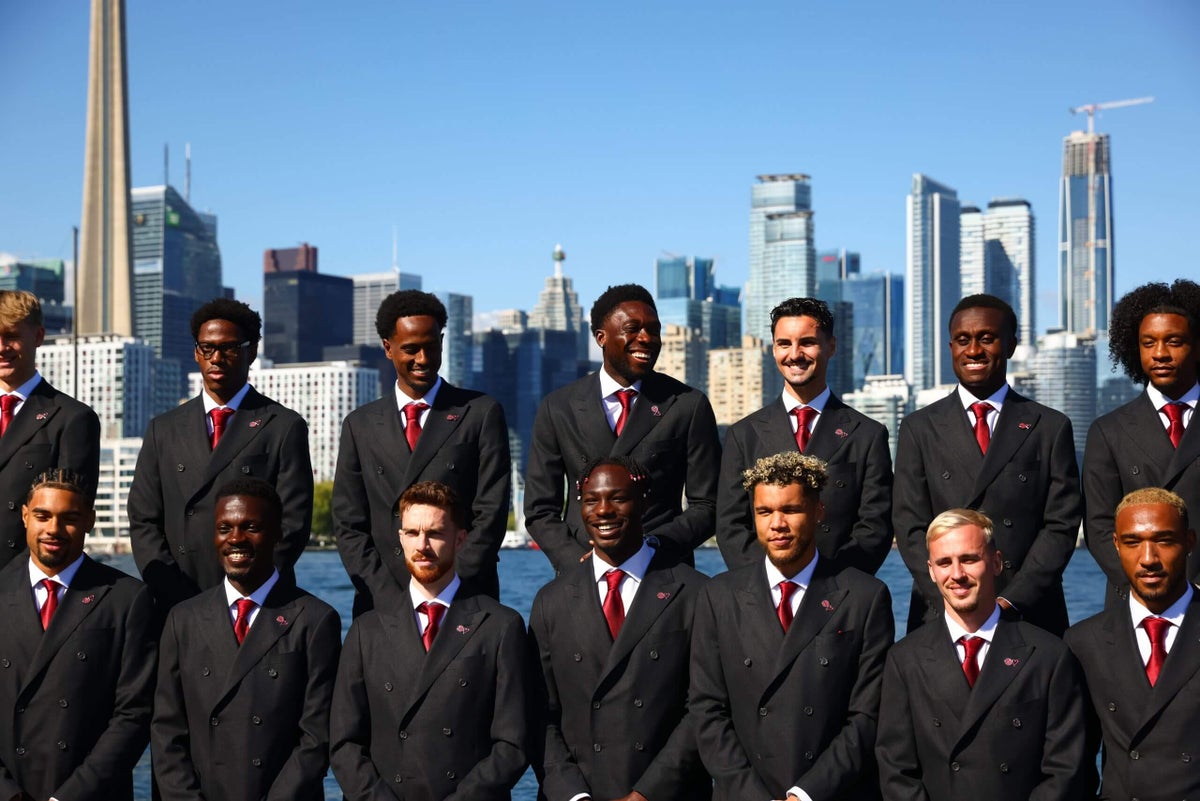
In preparation for the 2026 World Cup, I’ve spent the past five years around the Canadian men’s national team.
That’s probably not doing it justice, though: across North, Central and South America, I have filled multiple notebooks with quotes and observations from training sessions, media availabilities and every moment in between. I have flown with the team and hung around them in random hotel lobbies. I’ve conducted hundreds of interviews. I have seen players after losses in elevators, when they wanted nothing to do with me. I have constantly pestered the team’s communications staff. When this team has hit their highs, I have laughed at length with players and staff.
I’ve done all this with one unyielding goal in mind: To best understand the people who hope to change the nation during one of the biggest sporting events in Canadian history.
Because as much as the World Cup is the pinnacle of sporting events, this Canadian World Cup team are still searching for their moments in the spotlight as players and as people.
That could change this summer. Canadians could latch onto this group. But where will they start?
With the most important games in Canadian soccer history on the horizon, it’s time to meet the team. To do so, this is everything I’ve learned, and everything you might not know, about the 26 Canadians as people, not just as players, who will compete in the World Cup.
Goalkeepers
Maxime Crepeau, 32 (Orlando City, USA). Hometown: Greenfield Park, Quebec
What’s it like to play in front of Canada’s starting goalkeeper?
“It’s very calming,” Canada midfielder Jonathan Osorio said.
Spend a few minutes around the veteran ‘keeper and you’ll likely feel at ease as well. He doesn’t raise his voice. He speaks often, but in slow, thoughtful tones. Around the Canadian team, Crepeau’s reassuring approach can change a teammate’s thought process.
“When times get tough and those 10 players look back at their goalkeeper and see the look in Max’s eyes,” former Canadian forward Tosaint Ricketts said, “that will give them confidence. And it’s not a fake confidence.”
Dayne St. Clair, 29 (Inter Miami, USA). Hometown: Pickering, Ontario
What happens when you study communications in college and are elected to serve on the MLS players’ association executive board, responsible for decision and policy-making for MLS players?
You have opinions. Like, a lot of them.
Canada’s backup goalkeeper isn’t just vocal on the pitch — you can’t watch three minutes of a training session without hearing his bark from miles away — he is plenty loud off of it, too.

Dayne St. Clair is a man of strong opinions. (Jeff Vinnick / Getty Images)
“(St. Clair) always has something to say about everything,” Richie Laryea said.
That often manifests in opinions. No matter the topic, the 2025 MLS Goalkeeper of the year will chime in. He’s never short on confidence and preparation. Take a walk through Canada’s team hotel and you’ll see St. Clair set up in a meeting room with detailed activities to improve his movement and coordination.
And he’s likely to be just as detailed in debates, too.
“He’s usually the guy that, more often than not, will go against the grain,” Laryea said. “He sticks to what he thinks he knows.”
Owen Goodman, 22 (Crystal Palace, England). Hometown: London, England
Canada’s third goalkeeper likely won’t see a minute of World Cup action. But how much did Goodman still want to play for Canada regardless?
The London-born Goodman hired and paid for his own lawyer to help ensure he was eligible to play for Canada. Then, Goodman flew from London to Toronto — and back — within the span of just 24 hours so he could take his citizenship oath. That’s dedication and desire.
And that’s your starting goalkeeper for Canada at the 2030 World Cup, if I had to make a prediction.
Defenders
Moise Bombito, 26 (Nice, France). Hometown: Montreal, Quebec
As Canadian players will filter in and out of their meal room in the team hotel, they might hear a familiar sound. If there is a piano to play, Canada’s star centre-back will be sitting at it.
Bombito only began learning the piano in 2025, just before suffering a devastating broken leg. After first being taught in a local church in Nice, Bombito then used his recovery time to teach himself the piano via online tutorials.
“It really got to me,” he said of learning to play the piano.
Derek Cornelius, 28 (Marseille, France). Hometown: Ajax, Ontario
Canada has a “two-touch crew,” a group of players who practice keeping the ball in the air in a tight circle for long, long stretches after practice. Cornelius is always at the centre of that crew. And when a player fails to keep the ball in the air, Cornelius is quick to lay on punishment: A forceful flick of the ear with his forefinger. Cornelius is a low-key boss on the team because of his level-headed leadership.
“I try always to control my own emotions. I find that when you’re in that state of stress, that’s when the mistakes start to happen, when you make bad decisions,” Cornelius said. “Throughout my career. I’ve always just tried to keep a level head no matter what.”
The centre-back leads in his own way and after a winding career that’s taken him through Germany, Serbia, Sweden, Greece, France, Scotland and Canada, he could make his most notable impact at the World Cup.
Alphonso Davies, 25 (Bayern Munich, Germany). Hometown: Edmonton, Alberta
It can be tough to learn more about a player who has spent most of his career in bright lights. But Davies’ teammates insist the star left back is finding his way as Canada captain.
“A lot of the time you’ll see players that come from big clubs and going to their national team, they’re the superstars,” Cornelius said. “They don’t have to do the dirty work. They don’t have to do the sh**ty recovery runs. But Alphonso, he does it and without hesitation, without a complaint. A lot the guys just say, ‘Well, if Alphonso is doing it then we’re all gonna do it.’ As a captain, that’s really where he shows his value.”

Alphonso Davies is Canada’s star player. (Minas Panagiotakis / Getty Images)
Luc de Fougerolles, 20 (Fulham, England). Hometown: London, England
The week Canada spent in Kansas City before their second Copa America game against Peru in June 2024 was marred by oppressive heat. But as unrelenting as the heat was, De Fougerolles, one of the more intense trainers on the team, didn’t want to dampen his approach. He pushed the tempo as he always does in England.
And then, he threw up.
Then 18, De Fougerolles had only been around the team for a few months. But he couldn’t take his foot off the gas. Training had to be stopped because De Fougerolles wouldn’t stop.
“Everyone else was doing the same thing, but living in England for my whole life, I just wasn’t used to the heat. I was training the way I would normally train in England. And then… with 40C (104F) heat, you can’t really do that. You have to be smart. So that was part of the problem as well. I was doing what I would normally do in every session.”
Training so hard that he vomited earned him the respect of his teammates.
“(De Fougerolles) is a very good find for us because that’s someone who can play centre-back for us for the next 15 years,” Laryea said.
Alistair Johnston, 27 (Celtic, Scotland). Hometown: Vancouver, British Columbia
No Canadian player is as early for meetings, training sessions and bus departures as the well-rounded right back. And no Canadian player is as primed for a future in politics, should he choose, than Johnston. The most articulate member of the team, Johnston knows better than anyone how to talk his way through any problem. He is the team’s most natural leader. Johnston acts as one of the national team players association’s leading representatives.
“Everyone realizes from the moment they meet me that it’s completely genuine,” Johnston said of his leadership style. “It’s not like I’m putting on a face or putting on a show to try and win people over. No, this is just who I am. I like being involved. I like trying to help. I like to try to grease the wheels so that things move as smoothly as possible.”
Alfie Jones, 28 (Middlesbrough, England). Hometown: Bristol, England
Jones is one of the more affable members of the squad. He’s a composed and dominant centre-back who rarely makes a bad step.
While Jones was born and grew up in the UK, his grandmother was born in Hillcrest, a mining town just over 200 kilometres south of Calgary. He only completed his citizenship oath in November and has played one game for Canada. Jones’ grandmother moved to England as a teenager but his own interest in the region remained. So much so that when it came time to pick an NHL team as a new Canadian, one team in particular chose him.
“I’ve got my team, the (Calgary) Flames, now,” Jones said, after the Flames sent him a jersey.
He’s quickly found out what it means to be a fan of the Flames, who finished with the fourth-worst record in the NHL this season. In that sense, Jones is becoming more Canadian by the day.
“I’ve been doing a bit of research on them,” he said. “Yeah, it’s uh, been a tough year.”
Richie Laryea, 31 (Toronto, Canada). Hometown: Toronto, Ontario
Laryea is a battler. If there is a tackle to be won and a player to be out-muscled in the hopes of advancing the play along the way? Laryea’s effort will shine. He always thinks about the words of his first-ever coach as a child, Roberto Correa.
“He told the whole team, ‘If someone’s running at you with the ball, it’s either the ball gets by you or the man gets by you. But not both.’ I remember that to this day,” Laryea said.
Laryea was told for a long time that he wasn’t good enough to compete at the highest level. As he progressed, he also heard Canada wasn’t a proper soccer nation either.
Add it all up, and it makes for a passionate kind of rocket fuel.
“I see the player that represents Canada through and through, who shows what Canada is made of,” longtime Canadian attacker Junior Hoilett said of Laryea. “We’re fearless. That’s Richie — he goes into every game the same, fearless, ready to represent himself and his team at the highest level and go out to win every game, every moment, every challenge. He plays with his heart on his sleeve and he plays with that passion and that’s what Canada is.”
Niko Sigur, 22 (Hajduk Split, Croatia). Hometown: Burnaby, British Columbia
Once Sigur gets a move up the soccer ladder, as he is expected to this summer, the rest of the world will see what a dynamic, intelligent and creative defender and midfielder Sigur is. And then, more people will learn what I’ve seen from him in his two years with Canada: Sigur hates losing.
Canadian players are often frustrated but approachable after losses. Sigur, however, seems to create a bubble around him after losses. His look is piercing. His anger is palpable. I enjoy chatting with Sigur about soccer as much as any other player on the roster. But when I’ve seen him after losses, he just looks right through me and everyone else around us.
“(Sigur) is dialled. I love it,” Osorio said. “He’s very focused, sets very high standards and has very high ambitions for himself and for the program. I really resonate with that because it’s very unselfish, the way he carries himself.”
Joel Waterman, 30 (Chicago Fire, USA). Hometown: Surrey, British Columbia
In 2024, I was forced to stand on a chair to sing in front of the national team.
I was eating near the team the night before Canada’s Nations League quarter-final in Suriname. Mid-bite, players started pounding on tables. I looked up to see every player looking at me with mixes of grins and scowls.
One starter approached me with instructions.
“You are here, you have to sing,” the player said.
Why? Strange punishment for always bothering them with questions, I suppose.
I got up, walked towards the back of the room, where another player was preparing YouTube to play back-up music, likely to drown out my desperate singing voice.
“What’s your song?” they asked.
“Dancing in the Dark,” I replied, because everyone has to have a karaoke song in their back pocket and I adore The Boss.
“Rihanna? Weird choice,” the player said.
“No, Bruce Springsteen!” I said as I stood up on a chair.
For one verse and one chorus, I sang like no one was watching, even though the entire national team did so with faces in palms. I tried to turn another starter into Courtney Cox and pull them up on the chair with me. They threw their napkin at me.
Then, 20-plus players followed suit and threw their napkins at me.
I stepped off the chair, still confident in how I hit the low notes.
The next morning, I passed by multiple players who just shook their heads and laughed. The only player to stop me and cure my anxiety was Waterman. The centre-back might be one of the most positive and uplifting players on the team. He’s quick on his feet and just as quick with the right thing to say. Waterman said my voice wasn’t that bad. While he might have been lying, he also bolstered my confidence for a day.
On the field, I have a feeling he does the same for those around him.
Midfielders
Ali Ahmed, 25 (Norwich City, England). Hometown: Toronto, Ontario
Ahmed has ceaseless energy, can execute Jesse Marsch’s pressing game and has an attack-first mentality that allows him to thrive in Canada’s high-tempo system.
The only issue? There was a time, early in Ahmed’s national team career, when Marsch needed Ahmed to bulk up. Ahmed was wiry, yes, but skinny.
Ahmed has since added more muscle and size. And he’s done so in his own way.
No one on the national team has an appetite like Ahmed. The night before every game, Canada always gathers in their hotel for an all-you-can-eat pasta night. And Ahmed does not hold back.
“Two plates minimum,” Theo Bair, a frequent national team call-up, said of Ahmed’s work on pasta night. “Everyone waits to see how much he’s going to eat.”
“It’s a running joke within our team that really whenever we go to dinner you look up and Ali’s one of the first people in line,” Laryea said.
There has been a positive impact from Ahmed’s increased appetite. Teammates have witnessed newfound elite crossing abilities and a determined approach. Ahmed paid his own way to go on trials in Portugal as a teenager. He was told to go home. But Ahmed’s game has shot up, drastically improving under Marsch and after his transfer to Norwich City in England’s second-tier Championship.
“He was told he wasn’t good enough,” Laryea said of Ahmed. “He went an unconventional route. And now look at him. I don’t think he’s anywhere near his ceiling.”
Tajon Buchanan, 27 (Villarreal, Spain). Hometown: Brampton, Ontario
The snarl Buchanan plays with on the right side of the pitch can sometimes be felt off the pitch, too. He’s quick with his dribble and cross, but not exactly quick with a smile in front of the media. I’ve tried for years to crack him. Buchanan will talk soccer all day, sure. But comments about anything else, including himself?
Limited.
“I wouldn’t say he’s shy,” Canada and Villarreal teammate Tani Oluwaseyi said of Buchanan. “He’s very protective of his energy.”
For Buchanan, trust in outsiders is hard to come by.
“The thing about Tajon is, granted, he’s a serious guy, he keeps to himself,” Oluwaseyi said. “That’s just how he is as a person. But once you are close to him, you can see all of his personality.”

Tajon Buchanan is an extroverted player but a reserved personality. (Vaughn Ridley / Getty Images)
Oluwaseyi arrived in Spain after Buchanan. It wasn’t until then — even after spending time in Canada camps with Buchanan — that Oluwaseyi finally saw a different side of Buchanan.
“He was so helpful when I moved here. Always very forthcoming. Even in hard moments (in Spain), he’s been honest with me and I’ve been able to go to him through those moments,” Oluwaseyi said.
Mathieu Choiniere, 27 (Los Angeles FC, USA). Hometown: Saint-Jean-sur-Richelieu, Quebec
Canada’s set-piece specialist midfielder won’t draw plenty of attention. But there is a chance he could come on late in a game and sway Canada’s entire group stage with one set-piece kick. Until then, Choiniere will keep his head down.
“(Choiniere) is a guy that never gives up,” long-time teammate with Canada and Montreal Nathan Saliba said. “He always works hard, never gives up. His work rate is really high and this is something I saw early in our relationship together, back in Montreal, that he was a hard-working guy, whatever the situation was for him or against him, whatever, he was always working hard through it.”
Stephen Eustaquio, 29 (Porto, Portugal). Hometown: Leamington, Ontario
Ask around the Canada side for the team’s most competitive player and you’re likely to hear this answer more than once: Eustaquio.
Off the pitch, Canada’s vice-captain is the consummate professional: he’s always early, eats efficiently, respects everyone around the team for the important qualities they bring. The definition of a typical captain, in a lot of ways.
“He’s very proud of his work,” Crepeau said of Eustaquio.
On the field though? And, you know, in ping pong, or any slightly competitive game of any sort?
Eustaquio needs to win.
“He’s very intense,” Liam Millar said of Eustaquio.
If there is a bar on the Canada team, Eustaquio constantly wants to raise it.
“He demands high standards of people in training,” Millar said of Eustaquio. “In everyday life, he demands high standards of himself.”
Ismael Kone, 23 (Sassuolo, Italy). Hometown: Montreal, Quebec
There are two things I have learned about Kone, Canada’s starting box-to-box midfield maestro who could be on the verge of having a remarkable World Cup: The Montreal man has a big heart and big swagger.
Years ago, I shared in conversation that my son was starting to play soccer. Kone, who has no shortage of positive childlike qualities himself, grew super inquisitive. Over the next few years, life has come fast at Kone: a high-profile transfer to Marseille, one of France’s biggest clubs. A falling out with equally high-profile manager Roberto De Zerbi. Flashes of brilliance for Canada, and a public disagreement with Marsch. A move to Sassuolo in Serie A that settled his career. Some of his best performances in a Canada shirt.
All along, every time I have even passed Kone in a hallway, he is always quick to ask: How is your boy? He does so with genuine care and curiosity.
And, oh, about that swagger? The last time I spoke to Kone in May, I was telling him about how my son is dealing with frustration in not scoring. I asked Kone if he ever encountered this issue.
He grinned.
“Not in a cocky way, but I was always a bit better than the other (children),” he said. “I just remember having fun and just trying to dribble through everybody.”
Liam Millar, 26 (Hull City, England). Hometown: Toronto, Ontario
Yes, the Canadian winger’s recovery from a torn anterior cruciate ligament so close to the World Cup and his ensuing promotion to the Premier League (through the play-offs with Hull) is inspiring. And you’d be hard-pressed to find a more confident player on and off the pitch in Canadian camp.
But what makes Millar so endearing to this Canadian side off the pitch? You need to understand their favourite off-pitch activity: Mafia, the social deduction game.
Dozens of players play this game wherever they go. The goal is for one group of players (the Mafia) to eliminate others (the Townspeople) or vice versa. And to start every game, you need a trusted person to set the rules and facilitate the game. That’s the narrator, and that’s Liam Millar.

Liam Millar has an important, if surprising role, in the squad. (Vaughn Ridley / Getty Images)
“(Millar) has been doing it for so long,” Bair said. “When he actually plays the game, he gets super intense. Liam is a guy with big emotions. He loses his edge when he plays. Narrator is easier for him.”
The blazing winger is the one who gets his teammates together for off-pitch bonding. Millar takes it one step further. And his teammates appreciate it.
“Now, Liam will create a story in between rounds,” Bair continued. “Like, ‘This happened in Brampton,’ and it becomes really interactive. You’re laughing before you open your eyes.”
Jayden Nelson, 23 (Austin FC, USA). Hometown: Toronto, Ontario
When the winger found out he would be named to the World Cup squad as the injury replacement for Marcelo Flores, the first person he called was his grandfather, Owen Campbell.
“He was emotional,” Nelson said. “He’s not an emotional guy. He knows there was a lot of work put into this.”
Nelson believed it was important to call Campbell first. It was Campbell who got Nelson into soccer.
“This is going to actually be the first professional game he’s going to,” Nelson said of the upcoming World Cup.
Jonathan Osorio, 34 (Toronto, Canada). Hometown: Toronto, Ontario
Meet the new Godfather of the men’s national team.
Osorio is tied for second in all-time caps for Canada’s men’s side (90, level with Cyle Larin and 14 behind Atiba Hutchinson) and has been playing for Canada longer than any other active player. He debuted in 2013. Back then, playing in a World Cup seemed laughable for Canada.
But the driven Toronto captain kept raising standards on and off the pitch. He’s serious, and that’s what Canada needs. He recognized how important it was to play for Canada through their worst moments, when they fell to their lowest FIFA ranking (122) in 2014. When teammates take criticism in the media, Osorio is the likeliest player to stick up for teammates with journalists.
“I’ll call a spade a spade: There was a time when Canada was not respected,” Laryea said. “(Osorio) was part of that and for him to have seen that and to fast forward to 10 years later, that speaks to his character and ability. There are a lot of guys who aren’t here anymore. He’s still here.”
Laryea paused for a long time.
“Everyone appreciates that,” he added.
Nathan Saliba, 22 (Anderlecht, Belgium). Hometown: Longueuil, Quebec
If you’re looking for one of the breakout stars of this Canadian side that you might never have heard of, consider Saliba.
After his first full season in Belgium after a move from CF Montreal in MLS, it’s clear Saliba is on the verge of grander stages. Saliba’s big hair might grab the attention of onlookers. His skill will keep eyes on him. Saliba’s intelligence in tight spaces, ability to play forward with the ball and cut through defences could soon make him Canada’s next star.
“I’ve had to constantly adjust and improve to be able to fit in (the Belgian first division) and the new demands that it requires to fulfill to play proper football in this league,” Saliba said. “I had to learn how to be faster on the ball. I had to recognize my space faster, recognize pressure and everything that’s happening around you and knowing where your teammates are.”
Jacob Shaffelburg, 26 (Los Angeles FC, USA). Hometown: Kentville, Nova Scotia
It will be difficult to take your eyes off Shaffelburg’s curly mess of blond hair if he picks up steam on the left side of the pitch. The fearless left winger was the last man named to the squad after injury concerns. But he’s stepped over obstacles. Just like he’s stepped over … anything that’s coloured blue?
Shaffelburg might be the most superstitious member of the Canadian squad.
When the Nova Scotian walks through a parking lot, he’ll hop over disabled parking signs, just as he will anything painted on the ground in blue. He thinks he picked up these superstitions from his father. There are some real quirks in his personality, but Shaffelburg is still as real as they come.
Forwards
Jonathan David, 26 (Juventus, Italy). Hometown: Brooklyn, United States
Jonathan David presents unique characteristics. The Juventus man is Canada’s all-time leading scorer, but doesn’t say much publicly. Don’t mistake him for being standoffish, though. David might be the most influential yet unobtrusive trailblazer the Canadian team has ever had.
“What I’ve learned is that (David) is a leader in his way,” assistant coach Mauro Biello said. “He looks like he’s timid and quiet and doesn’t say much but he’s a leader. He is a man of few words but when he speaks, it’s real. And players value that because obviously he’s had success.”
If this Canadian team has success at the World Cup, it could be because of how David leads.
“I would say Johnny,” Buchanan said when asked which Canadian team-mate’s leadership style resonates with him. “When he speaks, guys listen because he doesn’t speak often. So when he does, everyone’s locked in and listening. And more, he leads by example on the pitch: Through his play, being able to score big goals and big moments, taking over a game.”
Promise David, 24 (Union Saint-Gilloise, Belgium). Hometown: Brampton, Ontario
The first time I spoke to Promise David, I knew he was going to be a handful for opposition defenders and Canada’s communications team.
I asked the 6ft5in (195cm) forward why he was having so much success in his first season in Belgium. He ended up bagging 24 goals in 41 games.
“Because I run motherf***ers into the ground!” he said, without overthinking his answer.
Have you ever heard a professional athlete use this statement in an interview?
Be prepared, Canada: If David (who goes by the nickname Toby) bangs in a goal for Canada (and it’s a very good possibility), he is the type to deliver the kind of postgame interview that will go viral. Since joining Canada in 2025, he’s quickly fit in. His irreverent and lovable style has made him a team and fan favourite.
“We need Toby for entertainment … or chaos,” Crepeau said. “Whatever he has in his mind, it comes out. What you see is what you get.”

Promise David tells it like it is. (Mark Blinch / Getty Images)
Cyle Larin, 31 (Southampton, England). Hometown: Brampton, Ontario
It can be difficult for players who only see each other a few times a year to form close bonds. That’s not the case with this Canadian team and Larin. He’s not only a veteran of the team but a very well-liked one. Larin is tied for second in all-time caps for Canada (90) and was once the program’s leading scorer. Everyone gets excited when they see the relaxed, constantly smiling big man and can drop his nickname.
“He’s got the nickname ‘Cheese,’” Cornelius said of Larin.
Cheese?
What I’ve gathered is Larin tried — before an away game far away from Canada years ago — to order a cheeseburger at a restaurant with extra cheese. Somehow, the name stuck.
“I came in and they were already calling him ‘Cheese,’” Cornelius said.
There aren’t a ton of publicly known nicknames on this team. But should Larin bag one of Canada’s first World Cup goals — he was in the form of his life with Southampton in England’s Championship before arriving at Canada’s camp — there could be a lot of Canadians thinking about cheese a little more.
Tani Oluwaseyi, 26 (Villarreal, Spain). Hometown: Mississauga, Ontario
The up-and-coming forward can run for days. His finishing is a work in progress, but Oluwaseyi learned a critical lesson during his first season in Spain that could help him during the World Cup: Stop being so hard on yourself.
“The biggest thing I’ve always been hard on myself about was the technical part of the game,” he admitted.
Oluwaseyi struggled through stretches in 2026. The pressure of an upcoming World Cup got to him. But he’s at his best when he’s playing with a smile. That’s come more when he’s not treating every game like the end of the world.
“A lot of times, I do have more time on the ball than I have realized. My overthinking when I was receiving the ball was detrimental. So it was a matter of changing my mindset.”
