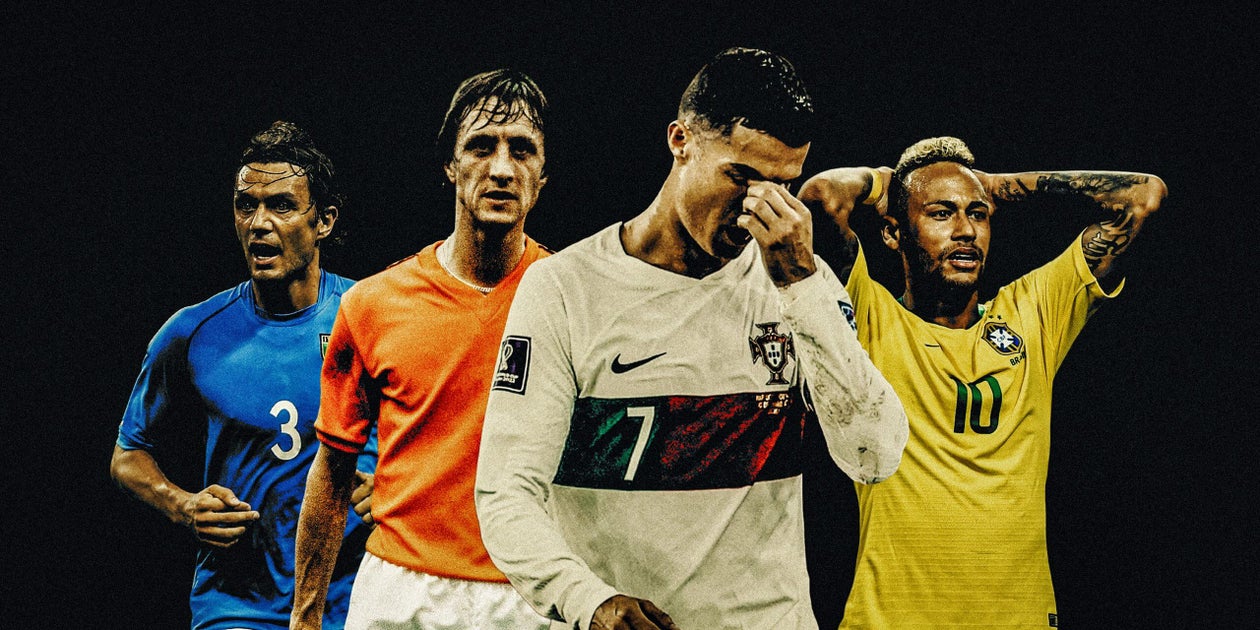
Notoriously unassuming, Cristiano Ronaldo once said: “I don’t follow records, records follow me.”
And of course he has a point. Ronaldo has scored the most goals in Champions League history, 140, and the most international goals, 143. He has won five Ballon d’Or trophies, more than any other European, and been runner-up six times. He has accumulated 35 major trophies in over 1,300 senior appearances across 24 years. To say he is one of modern football’s superstars can sound like understatement.
But Cristiano Ronaldo has not won the World Cup.
Given he turned 41 in February, this, his sixth World Cup finals with Portugal, will be the last opportunity. Portugal are ranked fifth by FIFA at the time of writing, and have an experienced, talented squad that should in theory ease its way through their initial group of DR Congo, Uzbekistan and Colombia.
But can Portugal win it? They reached the quarter-finals in their last two major competitions — the 2022 World Cup in Qatar, when Morocco won 1-0 and Ronaldo was a second-half substitute; and they were beaten in the last eight on penalties at Euro 2024 in Germany by France — Ronaldo scored his in the shootout.
In qualifying for these finals, Portugal won their UEFA group. It included the Republic of Ireland, Hungary and Armenia, whom Portugal hammered 9-1 in the last qualifier. Ronaldo was absent, but Bernardo Silva, Bruno Fernandes, Joao Neves and Vitinha were present. Portugal have arguably the best midfield on the globe and know how to retain possession in hot circumstances.
This gives Ronaldo hope. He will be fully aware the closest he and his countrymen came to reaching the World Cup final in his era was at his first tournament in Germany in 2006 when he was 21, not 41. Then Portugal lost their semi-final to a Zinedine Zidane penalty for France. There have been no real Portuguese near misses since.

A crestfallen Cristiano Ronaldo digests Portugal’s elimination to Thierry Henry’s France in 2006 (Michael Steele/Getty Images)
It has been different in Europe. Portugal, with Ronaldo in peak Real Madrid ‘CR7’ form, did win the 2016 European Championship in France. It is Portugal’s one and only major tournament trophy and was a huge achievement.
In the four World Cup attempts since Germany 2006, however, Ronaldo has experienced individual and collective disappointment. In 2010, in South Africa, the squad managed by Carlos Queiroz played four games — three in their group and one knock-out — and scored in only one of them. There was a 0-0 draw against Ivory Coast, 0-0 v Brazil and a 7-0 victory over North Korea. Ronaldo was named man of the match in all of them, so at least the sponsors were happy.
In the last 16, there was a 1-0 loss to Iberian neighbours Spain in Cape Town. If Ronaldo was seeking consolation, it came in the fact he scored the seventh in the 7-0 win over North Korea.
Spain were the eventual winners, of course, and four years later in Brazil, Portugal’s first opponents in their group, Germany, would also turn out to be overall winners. Germany won 4-0. Portugal then drew 2-2 with the United States but despite winning their last match 2-1 against Ghana with a late Ronaldo winner, they finished third on goal difference and were eliminated before the knock-out phase.
Russia 2018 brought Spain again in Portugal’s group and in the first match: it was one of Ronaldo’s greatest performances. He scored a hat-trick in an enthralling 3-3 draw in Sochi. For good measure he scored the only goal in the next game, against Morocco. A 1-1 draw with Iran completed the group, but Portugal faced Uruguay in the last 16 and lost 2-1.
In Qatar, by now 37, back at Manchester United but having just fallen out with manager Erik ten Hag, Ronaldo started his fifth World Cup finals with a goal against Ghana from the penalty spot. The goal meant he became the first player to score in five World Cups. He also became the second-oldest after Roger Milla, who was 42 when he scored for Cameroon in 1994.
Portugal then thumped Switzerland 6-1 in the last 16, with Ronaldo on the bench until the second half. There was belief in Portugal after that result, but against Morocco, they fell behind late in the first half and, while Ronaldo appeared from the bench in the 51st minute, Morocco held out.

Cristiano Ronaldo departs the pitch at Al Thumama Stadium after elimination to Morocco in 2022 (Alexander Hassenstein/Getty Images)
A day later, Ronaldo wrote to his 600 million followers on Instagram: “To win a World Cup for Portugal was the biggest and most ambitious dream of my career… I fought for it. I fought a lot for that dream. In the five times I was present in World Cups throughout 16 years, always next to great players and supported by millions of Portuguese, I gave it my all. I left everything on the field. I never faced away from the fight and I never gave up on that dream.
“Unfortunately, yesterday that dream ended. There’s no point in reacting hot-headed. I just want everyone to know that a lot has been said, a lot was written, a lot was speculated, but my dedication to Portugal didn’t change even for a second. I was always just one fighting for everyone’s goal and I would never turn my back against my mates and my country.”
He left Qatar for club football in Saudi Arabia and kept playing for Portugal. Ronaldo may not be a national starter any more but it is near inconceivable that at some stage he will not be introduced by coach Roberto Martinez for what will be his 229th cap. That’s a world record, by the way.
Only four men — Ronaldo, Lothar Matthaus, Rafael Marquez and a certain Lionel Messi — have played in five World Cups. Another appearance would make it six for Ronaldo, and for Messi, who has won a World Cup.
Speaking last November to Piers Morgan, Ronaldo poured scorn on the idea that, to cement his status, he needs to win it: “People say it is a dream (for me) to win the World Cup. No, it’s not a dream.
“Winning the World Cup will not change my name in the history of football. ‘Oh, Cristiano will be the greatest if he wins the World Cup!’ I don’t agree.”
When Morgan questions this, Ronaldo agrees he still would love to win the trophy but says it is not an “obsession”.
Nor should it be. The idea that not winning a World Cup is some kind of career ‘failure’ is preposterous. It has a heightened profile in today’s celebrity-driven football environment — something to which Ronaldo has contributed — but should Portugal not leave with the trophy in July, Ronaldo will nonetheless walk into the history books.
There, he will join some of the greatest players of all time. Alfredo Di Stefano did not win the World Cup. Johan Cruyff did not win the World Cup. Paolo Maldini did not win the World Cup.

The great Alfredo Di Stefano never won a World Cup (Evening Standard/Hulton Archive/Getty Images)
We have become used to Portuguese presence at major finals. This will be their seventh World Cup in a row. In part, it is due to the increase in skilful players emerging from a country of 10.5 million people — about half the population of New York State — but also to the expansion in qualification numbers.
There were 24 countries when the United States hosted the tournament in 1994 and 48 today. In 1994, even with Rui Costa in the team, Portugal finished third in their qualification group and missed out.
That was the 14th Portuguese effort at qualification, with just two successes. The first finals reached were in England in 1966, the next 1986, which helps explain why Eusebio is among the long list of distinguished players who have not lifted the famous trophy.
Eusebio came close. In 1966 he was 24 and the reigning European Footballer of the Year. Portugal were drawn in the same group as holders Brazil, meaning Europe’s best player, Eusebio, was up against South America’s best, Pele. They met at Goodison Park in the third and decisive group game and Portugal won 3-1. Eusebio scored twice.

Eusebio out-jumps Orlando to head past Manga in the Brazil goal at Goodison Park in 1966 (Keystone/Getty Images)
Remarkably, given Ronaldo’s goal against them in 2010, Portugal faced North Korea in the last eight. The Koreans were 3-0 ahead after 25 minutes; then Eusebio scored four. A semi-final with England at Wembley followed but, although Eusebio scored again, it was in a 2-1 loss.
That was that — in 1970 qualification, Portugal finished fourth in a four-country group. They failed to qualify in 1974 as well.
“I’ve been the best player in the world, the top scorer in the world, I’ve done everything,” Eusebio said in 2011. “I just haven’t won a World Cup.”
His last cap was a home qualifier in 1973 against Bulgaria, a 2-2 draw. Bulgaria topped the group and were stronger than we remember — in 1970, they had done the same, no mean feat considering Cruyff’s Netherlands and Kazimierz Deyna’s Poland were in the same group.
The Netherlands came third, meaning in 1974, when they reached the final playing Total Football, it was the first time Dutchmen had played at a World Cup since 1938.
Cruyff and Co lit it up. In the final against West Germany, they were 1-0 ahead after two minutes but lost 2-1. Cruyff was 27.
He was then part of the Dutch qualification for 1978 in Argentina. They won a group featuring Northern Ireland, which enabled Cruyff and George Best to be on the same pitch. But the last qualifier, at home to Belgium, was Cruyff’s last international. He avoided Argentina 1978, years later revealing a kidnap threat to him and his family.

Johann Cruyff dribbles past Argentinian goalkeeper Daniel Carnevali before scoring at the 1974 World Cup (STF/AFP via Getty Images)
Cruyff could echo Eusebio’s self-analysis, but then so could other legendary historic figures such Di Stefano, Ferenc Puskas, Lev Yashin and the player in 1999 voted Barcelona’s greatest of the 20th century, Laszlo Kubala.
Born in Budapest, Kubala played for Hungary, but also for Czechoslovakia. He was then initially included in Spain’s 1962 World Cup squad alongside Di Stefano (born in Argentina) and Puskas (born in Hungary). Kubala withdrew injured, but Di Stefano was on the bench in Chile and Puskas played all three group games. Spain still came bottom of their group.
Di Stefano had played for his native Argentina, then a Colombian XI before being allowed by FIFA to play for Spain. But a country so prominent today underwhelmed for so long, not least when Spain hosted the tournament in 1982 and exited tamely. Such a renowned football nation, Spain at last became world champions at the 17th attempt in 2010.
Raul, 102 caps, did not win the World Cup.
That summer of 1982 is recalled for the sun-dappled magic of Italy 3-2 Brazil and the fact Brazilians of the calibre of Zico and Socrates were eliminated by a Paolo Rossi hat-trick for Italy. Both Brazilians returned in 1986 in Mexico, but Brazil bowed out on penalties to France in the quarter-finals. It was the fourth of five consecutive World Cups Brazil did not win.
France did not win either, so Michel Platini is another on the list. Beaten semi-finalists in 1982 and 1986 — both losses against West Germany — France did not qualify for 1990, by which time Platini had retired.
Platini’s consolation is the company he keeps. Neither of his great French predecessors, Raymond Kopa and Just Fontaine, won the World Cup, even though, in Fontaine’s case, he scored 13 goals in six matches at Sweden 1958.

Michel Platini (right) was a three-time Ballon d’Or winner, but never won the World Cup (Charles Platiau/AFP via Getty Images)
France eventually won the trophy at home in 1998, but a peculiarity of Aime Jacquet’s squad is Claude Makelele’s absence. Makelele was 25. By the time of the 2006 final in Berlin, Makelele was 33. But France lost on penalties to Italy and a player with a role named after him joined the list.
Such sheer bad luck, timing, squad omissions, injuries and personal misfortune account for many names. Think of Platini’s two lost semi-finals, of Germany’s Michael Ballack, who was suspended for the 2002 final and was part of Germany’s beaten team in the semi-final four years later.
Demographics also affect chances.
Best played for Northern Ireland, a place of about 1.5 million people; George Weah for Liberia, population 5.5 million. Size restrictions have not affected two great over-achieving countries, though. Uruguay, 3.5 million people, have been world champions twice; and Croatia, population under 4 million, were finalists in 2018 and semi-finalists in 2022. Luka Modric is about to play in his fifth World Cup. No one thinks less of him for having not won it.
Mexico’s great defender, Marquez, played in five straight World Cup finals from 2002 and did not reach a quarter-final.
A disconcerting fact for Ronaldo, Portugal and most of the planet is that only eight countries have ever won the World Cup and no African, Asian, north American or Russian man is among them. No Dutchman has won the World Cup — including Marco van Basten and Dennis Bergkamp. The Netherlands have lost three finals. Even Ronaldo would not want that record.
He is not alone and should be reassured by the names here. Aged 34 and injured, Neymar’s could be added. There will another beaten finalist on July 19 in New Jersey. It is unlikely to be considered a failure.

Brazil’s brilliant forward Neymar (left) is another never to have won this trophy (Fabrice Coffrini/AFP via Getty Images)
And to return to the previous World Cup final in the United States, there is Roberto Baggio. Baggio played 16 matches for Italy in three World Cups — 1990, 1994 and 1998. He fell between the Italian sides who won in 1982 and 2006.
Baggio took what proved to be the last penalty in the shootout in the 1994 final against Brazil. He missed and it defined him. But only partially, because the image of that effort in the Rose Bowl in Pasadena omits the two goals Baggio scored to send Italy through in the last 16, the winner he scored in the quarter-final against Spain and the two against Hristo Stoichkov’s Bulgaria with which won Italy the semi-final.
No, Roberto Baggio did not win a World Cup, but he is a cherished player.
Whether it truly matters to Cristiano Ronaldo, we do not know. But there is more to an elite career than a World Cup winner’s medal.
