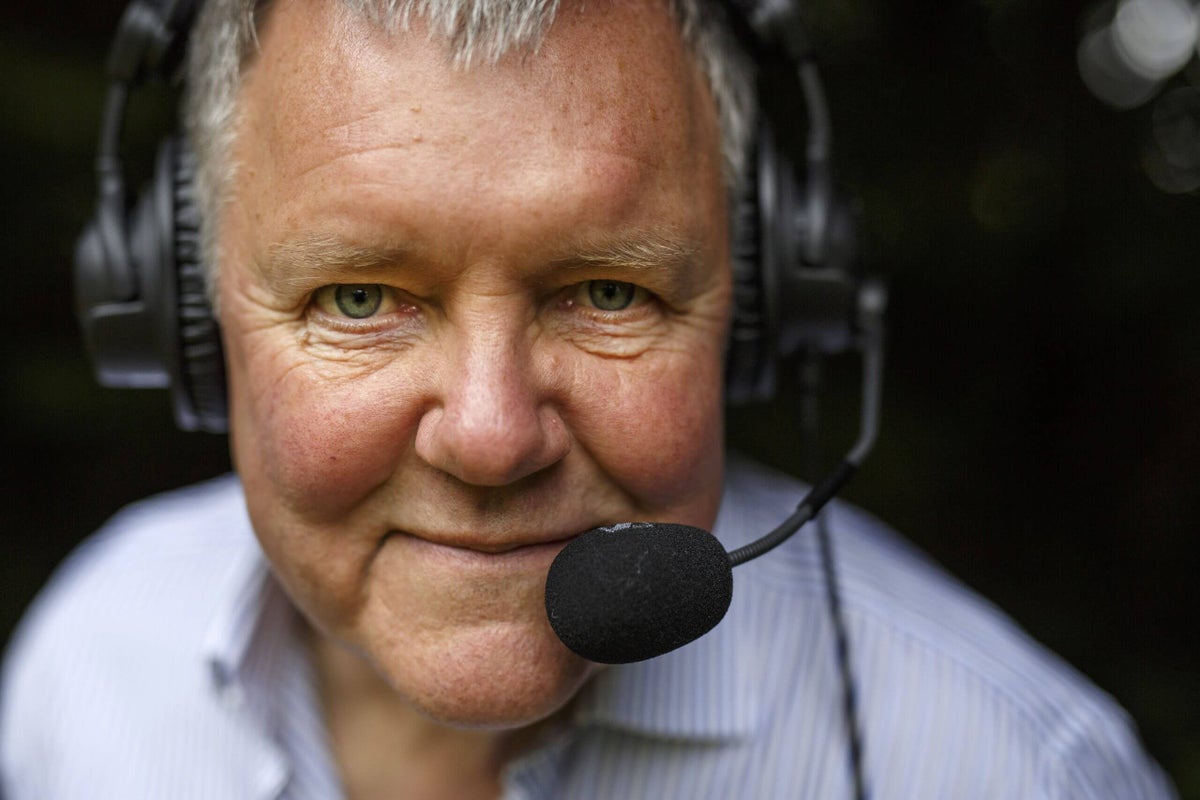
Clive Tyldesley pours himself a glass of red wine and reminisces about the first time the World Cup came to the United States. It was, he says, a very different time.
“I was in my hotel room, preparing for my first game, when the helicopters were flying over,” he says, in that distinctive story-telling manner, familiar to millions. “O.J. Simpson had taken to the road in his white Bronco and all the police cars were in pursuit. And that story just took over everything.
“I was based on the West Coast and I actually took Terry Venables (then the England manager) on a tour of the two murder sites.
“At the same time, there was a particularly dramatic NBA finals going on (the Houston Rockets against the New York Knicks) and the same in the NHL finals (the New York Rangers against the Vancouver Canucks).
“It was almost as if the rest of American sport was ganging up on the World Cup. It was all happening in the shadow of other events — O.J., mainly — which I don’t think will be the case this time. Though, of course, other shadows might appear during these finals.”
The man sitting here today, with five decades of broadcasting behind him, can be regarded as the godfather of commentary bearing in mind the number of years his expertly delivered words have been beamed into people’s living rooms. And newsflash: he is speaking to The Athletic fresh from agreeing a new two-year contract with CBS Sports, which has the broadcast rights to the Champions League in the United States.
We are going to talk about the changing face of his industry, the things he likes (and, just as importantly, the things he doesn’t like), the emergence of “fanboy” commentators, the advice he gives to Ally McCoist, among others, and the challenges of holding the microphone when Benfica’s Gianluca Prestianni was accused of racially abusing Vinicius Junior during a Champions League tie against Real Madrid last season.
We will discuss how, six years on, Tyldesley reflects on ITV’s decision to remove him as their lead commentator in favour of Sam Matterface. And there are some fascinating insights, too, when the subject turns to his favourite sports commentator of all — and what some of his peers could learn it from, perhaps.
“When I got the NFL bug in the 1980s, part of the magic for me was listening to Pat Summerall. It wasn’t Pat’s words so much as the way he delivered them. The timing, the phrasing, the capture of the moment through tone and texture rather than froth and hot air. ‘Montana … to Rice … touchdown’.
“There are a number of contemporary commentators who escape much in the way of scrutiny of their vocabulary or content, because they are blessed with strong voices. Observers seem to take a curious pleasure in hearing commentators totally losing themselves in moments of drama, as if screaming inane verbiage while frothing at the mouth is some kind of broadcast skill.
“Summerall was cool and controlled. He used his choice of words and sense of rhythm and timing to augment sporting drama. He was beautifully economical, understated, succinct. Phrases, not sentences. There was a modesty in his work because he saw the theatre in the action, not in his own performance. No hype, no attention-seeking. Great sport needs reflection and capture, not amplification. It was never about him. I hope that I at least try to follow suit.”
The industry is evolving. More words, more voices, more banter in some cases. It is important, Tyldesley knows, to move with the times. But only, perhaps, if it is for the better.
“I am open-minded enough to know our profession is changing by the day,” he says. “But the essence of commentary has not changed since the days of national (BBC/ITV) treasures such as Brian Moore, John Motson and Barry Davies. We are there to add something to what you are watching.
“I don’t think we should ever believe we can get in the way of the pictures, and occasionally I’ve found myself watching matches on TV with the feeling that I’m in a cinema, trying to watch a movie, and there are two guys behind me discussing that movie.
“I understand the podcast generation has given us a more conversational approach and I will listen to anybody who tries to make a case for the three-person commentary booth, the fan commentator, the referee expert and all the other innovations that have been made.
“But I will also challenge them if I don’t see what they are adding, or if I feel they have been added as a gimmick, a trend, a fad, rather than something that will enhance the viewer’s experience.”
Two’s company, in Tyldesley’s experienced opinion, whereas three can make it a slightly awkward crowd.
“The danger with a three-person commentary booth is that you start to talk to one another, rather than the audience. It can feel (as a viewer) like you are trying to get to the bar and there are three guys sitting there. You can’t quite get the attention of the bartender and all you are hearing is their conversation about what a great night they are having.”
Tyldesley’s first working World Cup was Italia ‘90, operating from the BBC studios. Since then, he has covered every tournament and commentated on the World Cup final for ITV in Japan, Germany, South Africa, Brazil and Russia.
It might, therefore, feel like something is missing over the coming days and weeks. He has decided, unannounced until now, to turn down various offers of work at this summer’s tournament, ending a run of 18 international championships in a row.
Tyldesley has been to every European Championship since 1992, as well as covered almost as many Champions League finals as he has fingers and toes, travelling tens of thousands of miles doing the job he loves.
He is, in short, a football man down to his bones. Yet, first and foremost, he is an aficionado of broadcasting. It is his art, his passion, going back to the days when the late boxing commentator Reg Gutteridge became, unofficially, his mentor. It was, says Tyldesley, “tough love”.
Tyldesley now passes on his wisdom to students at Salford University in Greater Manchester. He makes it his business to help enthusiastic newbies, as well as some of the already established commentators who ring regularly for feedback and advice. And he takes a lot of pleasure from building relationships with the ex-players who have doubled up with him in the commentary booth. McCoist, for one.
“Ally is a great one for a name-check,” says Tyldesley, instinctively smiling. “It’s lovely, like someone giving you a massage. ‘I’m not having that, Clive’. But I’m as hard on Ally as Reg Gutteridge was with me.
“When I’ve sat down with him after games with a glass of wine, my message has always been, ‘You’re Ally McCoist — after Denis Law and Kenny Dalglish, you’re probably the most iconic Scottish footballer of all time. Your CV and your ability to analyse football is up there with anybody. So, don’t lapse into light entertainment’.

Clive Tyldesley with co-commentator Ally McCoist (Courtesy of Clive Tyldesley)
“The great quality of the modern broadcaster — Bradley Walsh, Declan Donnelly, Dermot O’Leary — is to look down the black hole of a television camera and make us feel like they’re our friend and that we’d like to have a drink with them.
“Ally McCoist is that person. ‘You will make us smile because that is who you are’, I’ve told him. ‘You have that ability to reach the hearts of millions of people you will never meet’. But, as a pundit, he is as serious as anybody and I want to promote that when I commentate alongside him.
“I don’t want it to get matey. I don’t want it to get Statler and Waldorf (two characters from The Muppets). I don’t want it to get ‘where we were having dinner last night, or where we’re going for a drink later’. Because I think Ally is so much better than that.”
His own career is very much back on an upwards trajectory as the voice of football for CBS Sports, his new contract criss-crossing the time, from 2027 onwards, when the broadcaster’s streaming partner, Paramount+, acquires the UK rights to the Champions League. It is, for now, a largely American audience and that means he and his regular co-commentator, ex-England goalkeeper Rob Green, speak in dollars not pounds.
Otherwise, his bosses encourage a European approach. It works. CBS Sports has been widely praised for its bright, considered and sparky coverage.
Life is good. Last month, Tyldesley was at Windsor Castle with his wife, Susan, to receive an OBE from Prince William for services to broadcasting and charity. “It was the most beautifully delivered occasion,” he says. “I haven’t got the right to complain about anything when I’m doing the job I always wanted to do, and I have the loving family that I have. I’m a very happy man and, in many ways, what ITV did six years ago has made me appreciate how lucky I am.”

Clive Tyldesley receiving an OBE from Prince William (Courtesy of Clive Tyldesley)
That brings us neatly on to the subject That Never Really Goes Away if you are Clive Tyldesley (or for that matter, Sam Matterface), six years since the 30-second telephone call that turned his professional world upside down.
Is time a healer? “Dara O’Briain (the comedian) said to me, ‘You’ve had the benefit of reading your obituaries before you’ve died’,” says Tyldesley, reflecting on the tributes that came his way, as well as the frothy, polarised debate that ensued. And yes, the sense of hurt has gradually subsided.
“It did cut deep. I had been given my games for that summer, commentating for ITV on the main games, and then suddenly — and it was suddenly — I was being told, ‘We think we have got someone better than you’.
“I think Sam Matterface is a good commentator, a really good commentator. I’ve never said a bad word about him — and I wouldn’t. It wasn’t about him and me, it was about somebody else’s opinion.
“I think Sam’s one of the best 10 commentators out there. So it’s not as though ITV replaced me with someone who couldn’t do the job. They replaced me with someone who did the job differently to me, which actually was a consolation, because they weren’t replacing like for like. But it’s a long time ago. Other opportunities have come my way, and my life is rocking along quite nicely.”
It has been some ride since Tyldesley’s first experiences with a microphone, as a freshly graduated economics student in 1975, working for Radio Trent in Nottingham.
And it is not an easy profession, whatever you might think at home. It is one thing getting the basics right, not getting the players mixed up or mispronouncing a name. It is something else, however, to know the art of the clipped delivery, understanding the value of language, for 90 or 120 minutes.
Then consider the moments — Prestianni vs Vinicius Jr, for example — when the man with the microphone cannot afford one misplaced word.
“You are stepping through a minefield because you are making personal judgements on subliminal pictures,” says Tyldesley. “The rest of the world is raging, one way or another. You are the voice that’s being heard by millions and there is nothing you say as a commentator that you can ever take back.”
It isn’t made easier by the people on social media he calls “the buzzards” who are “hovering above, listening to every word and tweeting, ‘Did he just say something offensive, something insensitive?’”
But it helps, of course, that he has a vast pool of knowledge and experience in his favour. “I have been there before,” he says. “I also did the England games in Bulgaria and Montenegro where there were racial-abuse incidents. During the game in Bulgaria there was a close-up of Raheem Sterling and I said out loud, ‘What must he be thinking?’
“He almost had a wry smile on his face, as if to say, ‘Here we go again’. So the next thing I said, answering my own question, was, ‘I will never know’. If I’m proud of any line that I’ve said off the top of my head, that was it.”
Preparation is key. Tyldesley does a roaring trade these days with the framed prints of his beautifully created, almost impossibly neat, commentary notes (more than 55,000 sold so far). He spends endless hours researching and putting together his notes for each game. So, for example, his “Kai Havertz goal file” came in particularly useful when the relevant player opened the scoring for Arsenal in last month’s Champions League final.
Fav fact tonight – QF. Dembele scored R+L foot. R16 Barcola + Kvarat both scored R+L feet. PO Rnd rt ftd Doue scored 2 with lt foot. Ballers! @CBSSportsGolazo today at 15:00 pic.twitter.com/z0cNEpHLxu
— Clive Tyldesley (@CliveTyldesley) April 28, 2026
“I had the round-of-16 details ready, his quarter-final goal, and obviously the one he scored for Chelsea against Manchester City (in 2021),” says Tyldesley. “So if it’s something as gleeful as, ‘What did Kai Havertz’s goal mean?’ I can say in commentary, ‘He’s been here before … he’s scored in a Champions League final before … Arsenal’s golden goalscorer.’
“I can rattle through what he’d done previously. ‘When Havertz scores for Arsenal, he scores goals that matter’. And that all comes off the top of my head. If I sound proud of that, it’s only because Reg Gutteridge would have been on the phone the next morning to say, ‘That wasn’t bad’.”
Is everyone the same? This, it turns out, is one of his concerns about a lot of the other commentators on the circuit, many of whom are freelance these days and cover three or four matches every week for different platforms.
“Personally, I feel as if two is enough and that’s where I worry for the modern generation of commentators,” says Tyldesley. “I think it does compromise them a bit. If anyone, I blame the editors because I think, before you employ a commentator, you should ask, ‘How many other games are you doing this week? I want the game you’re doing for me to be the really special one’.”
What will Tyldesley be doing during this World Cup? Watching football for the most part and, inevitably, analysing the different commentary styles. It matters. He cares deeply about his profession and doesn’t want standards to slip.
“Air time is precious,” he says. “It’s not easy, because it’s not a scripted piece and things are changing all the time. But I hear some commentators who don’t think about what they are going to say next. I hear commentators who say so many words they get behind the action.
“It’s just a stream of consciousness and that’s not good enough, because what comes next is being heard by millions of people. It’s got to be something more than the viewers are thinking themselves. Either that or shut up! Let them (the audience) take it in and give yourself time to think about what to say next.
“Reg Gutteridge would always say to me that, ‘Silences are golden, but they’re not resting time, they are thinking time’. They are times for you, as a commentator, to assess what you are watching and make an observation which adds to people’s consumption of what they are seeing. That is probably the guiding principle. Try to make every 10 seconds count.”

Clive Tyldesley commentating on a 2015 England game (AMA/Corbis via Getty Images)
Some viewers complain that it is wrong to have co-commentators in place when they are so closely aligned to one of the clubs — Gary Neville with Manchester United, for instance, or Jamie Carragher with Liverpool.
Tyldesley disagrees with those examples. “Gary is as harsh on United as anyone could be,” he says. “He’s very serious about broadcasting. Jamie is very serious about broadcasting. I’ve heard one or two others in that position, however, who are just fanboys.
“They’re calling people by their nicknames, they’re shouting, ‘Unbelievable!’ and, ‘Oh my God!’. Is, ‘Oh my God!’ OK in commentary? Apparently it is. But I can think of bosses who would say, ‘You can’t say that’.”
It is Tyldesley’s gift, undoubtedly, that he can decorate the ‘OMG’ moments with clear, controlled observations. Yet, above all, one thing is absolutely clear from time in his company.
“I think football is tired,” he says. “I’ve seen a lot of Premier League games this season which have disappointed me. I’m trying to work out whether the Qatar World Cup threw everything out of kilter, or whether the Club World Cup was a step too far. I have reached the conclusion that, yes, it probably was, and that football is weary.”
So why are his eyes twinkling? “And then I go to Paris and (blows out his cheeks) I see that game …”
Paris Saint-Germain 5, Bayern Munich 4.
And these are the moments, six weeks on when you are reminded that Clive Tyldesley is still head over heels in love with the game that has shaped his life and career.
“On the way back from Paris, people are saying, ‘Was that the greatest game you’ve ever seen?’” he recounts, that keen voice going up an octave. “I don’t want to get involved in that debate, because I don’t like comparing then with now. Then I watch it back the next day because I’m hearing people saying the defending wasn’t very good. Nonsense!
“I’m 71. I saw George Best, Bobby Charlton and Denis Law. Diego Maradona. Lionel Messi and Cristiano Ronaldo. And, yes, that football match in Paris might just have been the greatest game I have ever seen. This old cynic, this old sceptic, was sitting in a commentary position with his jaw open.
“That has really lifted my year. My heart lifts to think there are still guys out there, great coaches, almost reinventing the game. Vincent Kompany (Bayern) and Luis Enrique (PSG): ‘OK, we’ll take them on’. That means so much to me.”
