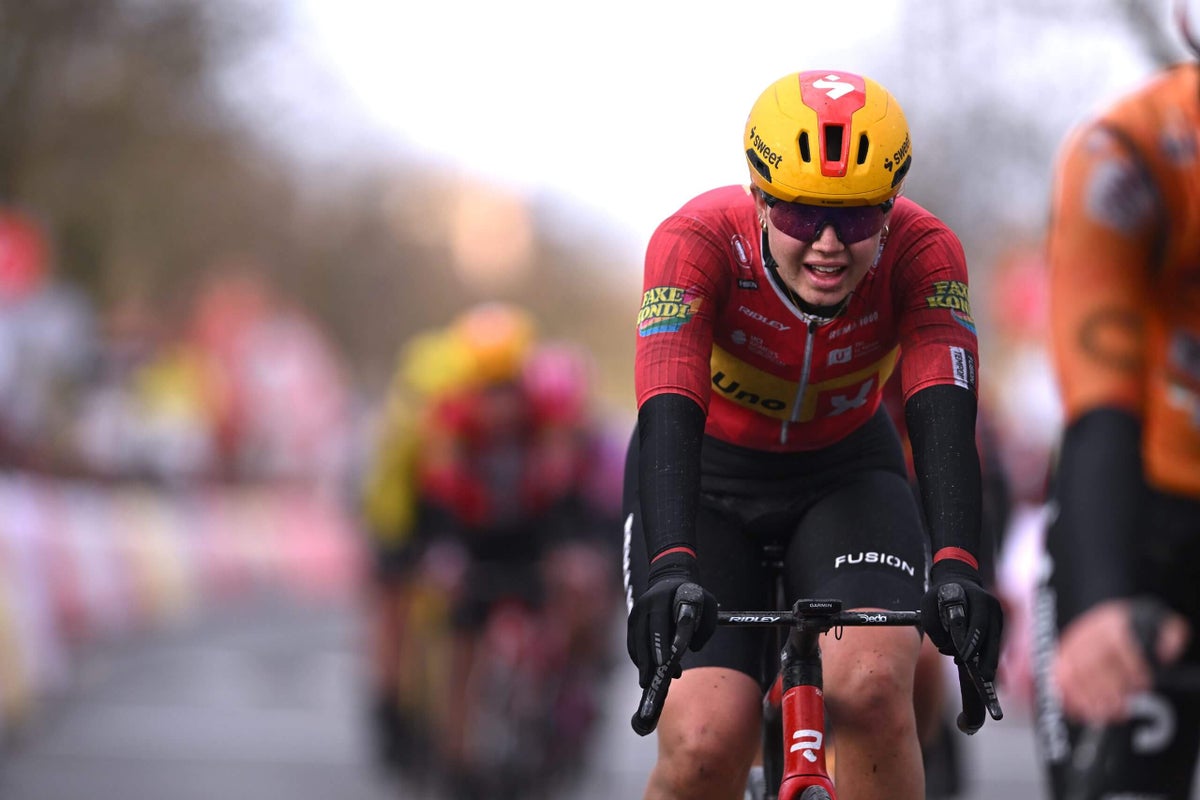
On April 12, 19-year-old Kamilla Aasebø rode her first Paris-Roubaix, the toughest and most iconic of cycling’s Monument classics.
The 2025 Norwegian U23 road race champion — third in the senior women’s road race — is one of the country’s top prospects, racing for Scandinavian team Uno-X Mobility.
She was perfectly positioned in the main bunch with 50km remaining, when, two wheels ahead of her, a competitor went down. A crash was unavoidable.
Aasebø found herself lying on the cobbles with elbow and jaw injuries, and was sped to hospital. That evening, doctors discovered a brain bleed — which left her in a life-threatening condition in intensive care.
Five days later, on regaining consciousness, she realised she had no movement in her right leg. It would be two weeks before she could return to Oslo to begin her rehabilitation.
Two months on from Paris-Roubaix, Aasebø has recovered enough to get back on her bike. She spoke exclusively to The Athletic immediately after returning from her first ride outside since her crash — sharing a story of shaved heads, panic attacks… and hot dogs.
Jacob Whitehead: Kamilla, it’s so good to see you back riding after your accident. I think everybody was shocked when they saw the pictures and learned just how serious your condition was in hospital. Apologies for the generality of this question, but… just how are you doing right now, two months later?
Kamilla Aasebø: “I’m feeling really good lately. It’s been really nice that rehabilitation is going so much quicker than expected — I think I’ve come quite far already. Back at the hospital, and also speaking to the team doctor, we thought it would take a bit longer.
“But I think that what comes now might be the toughest part. What I’ve been through already was obviously quite serious, but I wasn’t really awake at that point. I didn’t know what was happening. Now, I’ve got to be patient.
“Every step so far in my recovery has actually been quite easy to see — getting the movement back in my leg, removing wires from my jaw — and it meant I could see the progress day to day. But now I’ve just got to wait.”
JW: Is there anything you can do to keep mentally busy, as well as the obvious physical rehab?
KA: “Yes, actually. The (women’s) Giro finished yesterday, and our directeur sportif was giving me a kind of homework. He sent the team plan so I could review it, asked me if there was anything I noticed, any ideas I had that could help. It made me feel involved.”
JW: You might end up being the youngest DS in the peloton…
KA: [laughs] “Yes, for sure! But I’m also a young rider, and I was looking forward to riding this summer, to gain more experience, to help me become a smarter rider. So hopefully this will help me.”
JW: So, if we go back to the start of your season, just how significant was Paris-Roubaix? Did you always know you were building towards it, or was it a reward for your form?
KA: “Yeah, my season went really well in the beginning. Roubaix is a really cool race, but I also thought it was a race that would suit me, because I’m more of a Classics rider, but I also have a background in mountain biking, and I think my handling skills are quite good.
“So I knew quite early I would do it and really targeted being in shape for the race. I took some nice steps in the winter — my goal was to be able to ride into the final and be there towards the end. I was able to save my energy, because me and Susanne Andersen were probably our leaders — her for the sprint, but me to follow late moves.
“The part of the race after I crashed was my time to shine, you know?”

Aasebø had been in great form on the cobbles earlier in the spring (ELIAS ROM / Belga / AFP via Getty Images)
JW: Do you remember any of the race itself?
KA: “I do actually. I remember everything, from the day before the race, to how it went in the beginning, until some time after the crash. I see everything really clearly, actually.
“I was in the middle of the main group, a bit more towards the back, and I saw the rider a bit in front of me on the right-side crashing, her bike suddenly rising in front of me. Sometimes there’s a moment where you understand that now you’re going to crash. You have time to think about it. And then you do.
“I landed on my jaw, I think I went like this. [She mimics going over her handlebars]. But it happened really fast. The first thing I noticed was that I had broken a piece of one of my teeth. I remember some spectators coming towards us to help, and a woman looking at me and touching her jaw, I think she was giving me a hint. I put my finger to the wound, and it was quite deep. Like, all the way to the bone.
“But what I was most worried about was being on the road with riders coming. I wanted them to move me, to help me get out of the way. But I also felt like it could have been a crash where I just got up, took my bike, and carried on. (American former time trial world champion) Chloe Dygert was lying next to me completely still, other girls weren’t moving, but I was just sitting there fully aware.”
JW: So what happened after that?
KA: “My body was actually working like normal, I felt at this moment. My legs were fine. When I got into the ambulance, I remember thinking that my teeth weren’t straight anymore, because nothing fitted if I closed my mouth. It was because my jaw was broken in two places, but I was just worried about my nice teeth!
“At the hospital, they cut off my race suit to clean my wounds. I was completely alone for a few hours because our doctor was at the race. And it was quite tough, because the nurses didn’t know English and I don’t know French, so it was really hard to communicate.
“To be honest, I was lucky I wasn’t told that I had a brain bleed at that point. Nobody was particularly concerned — they told the doctor I had a small bleed, but when I went to bed, I felt ok. My elbow was fine, they had put stitches in my jaw, and I was just a bit bummed that I had to stay at the hospital for several days for observation.
“The next evening, I had surgery on the jaw. And after they put me to sleep for that, I don’t remember anything for five days.”

Aasebø suffered a deep wound to her chin in the incident (Photo: Kamilla Aasebø)
JW: So did they realise the bleed was worse than they thought? Or have you had to piece everything together since then?
KA: “They had warned my parents that the surgery could take some time. And when they tried to wake me up afterwards, apparently I had a panic attack, so they gave me more medication.
“My parents came in while I was sleeping, but then I woke up thirty seconds later and was in full panic mode again — moving everything in my body except my right leg. That was just completely still, while the rest of me was in full-on panic mode. They understood quite quickly that I wasn’t myself any more.
“They put me to sleep again, took some new scans, and could see that the bleed was quite a lot bigger. It was quite serious at that point. They said that one surgery was finishing in the next five minutes and they would rush me in to operate straight after.”
JW: So it was life-threatening at this point?
KA: “For sure. It was really dangerous. But as I said, I wasn’t awake. Luckily, after the brain surgery, I was more myself. But I was still falling asleep every thirty seconds; I would forget what we had been talking about, I was confused about the day and night.
“After five days I didn’t have much pain anymore, so I could stop taking morphine. That’s the first day when I can remember how it was.”
JW: When you become aware of everything, what did you notice about your leg?
KA: “It still wasn’t moving at all. And when my father visited me, he asked, several times, if I could try to move it. But I couldn’t, and to be honest, I just found him annoying that he was concerned about that.
“It wasn’t until maybe the 10th day, towards the end of my stay in France, that I could move the toe a bit. But the doctors had been quite sure that I would gain the movement back, but for sure, my parents were really worried about this. They pictured the worst-case scenario.
“Then, for me, I only realised what I’d been through during visiting hours. My father asked if I’d seen under the bandage around my head, and I said: ‘No, I haven’t’. And then I was like: ‘S**t, I have no hair.’ I wasn’t really worried, but more just in shock. I called my parents several times, just trying to work out what had happened.”

Kamilla was treated in a French hospital for more than 10 days (Photo: Kamilla Aasebø)
JW: So, they flew you from Lille to Oslo after about 10 days. How long was it before you were able to walk again? Can you walk normally now?
KA: “It all went super fast once I started wiggling my toe. They made me stand up at the airport when I got to Oslo, and I tried walking a little bit with a frame in my hands. And from then, I could see progress every day.
“After getting to Oslo, I started to walk with my mom outside. I wasn’t walking properly, I was stomping around, but still, I was walking, which was just really good. It was maybe three weeks after that I felt like I was walking properly. My whole body was a bit changed. If I touched my leg muscles, it was like there was nothing there. I dropped about five kilograms from just 10 days in France.”
JW: And it’s easy to forget — you were still in a big, unwieldy jaw wire at this point?
KA: “I was. And it was so hard to eat or drink anything! Everything in my mouth was closed, so everything had to come from between my teeth. A straw didn’t really help because it couldn’t go inside my mouth. If I had a smoothie with strawberries and raspberries, it would not have been fine enough to go through, so you had to make it super thin.
“I could have soup and drinks, that was it. Also these nutri-drinks that have a lot of calories in them. So when I started drinking, I could also gain some weight, but it was still really hard to get enough.”
JW: I heard about a hot dog… where does that come into all this?
KA: [Laughs] “Oh, it was when I was in the hospital, not that many days after my surgery. I was in the room with my parents and Rory (the Uno-X doctor) was also there. I just said something like: ‘I’m really craving a hot dog’.
“It’s funny, I see on my phone camera roll that I took a screenshot of a hot dog — like, ‘I want that one!’ Everyone else thought it was a bit funny, because it’s not like hot dogs are my favourite food. It was just what I was craving.
“So then when I could finally take out this wire after six weeks, I was pretty fed up of drinks. It was a milestone to get it out. And so we had talked about a hot dog in the rehabilitation group that the team had put together — and then, on that special day, the first bite was amazing.
“And it was really funny, because suddenly I got this video that Rory had taken of all the men at the Giro, the team, the staff, and all of them were having a hot dog with me, which was really nice.”
JW: You must have felt so supported…
KA: “Yes, but I was also thinking: ‘I don’t think that’s the right food for them in the middle of the Giro!”
JW: That must be your newfound inner DS brain talking! So, once you had the wire taken out, what was your road to getting back on the bike today?
KA: “Since I got back to Oslo, the team gave me this spinning bike that I could have in my room. So I started with just five minutes a day, spinning my legs, and to be careful with the head for sure. I think we expected more headaches and becoming tired a bit more quickly. I still feel affected, especially after I first came home — if I was being social, I got tired a lot more quickly. So the rule we had is that if I felt a headache or felt bad, I wasn’t riding the bike.
“Because of my elbow injuries, as well, I had this thing I could put around my chest to support me, so I wasn’t putting my weight on the elbow. And I could just feel that my body was ok with doing more and more, gradually just building it up.
“There’s so much more happening when you’re riding outside. There’s noise, there’s traffic, and you’re looking at the surroundings, which is more for the brain. But it’s really good actually, because the team carry out this concussion test before every season to provide a baseline. I’ve done two since my crash and the results have been quite good. So I was cleared — and yeah, I was really happy to be able to go out.
JW: Were there nerves around it, or trepidation at least, given what happened last time you rode?
KA: “It was mostly just excitement. Even though I’m not riding for long, it’s mentally hard to ride the bike inside, even though we’re used to it in Norway in winter with the snow. But this happening in summer was even worse, because it’s really nice weather outside and I’m just stuck inside. So it was just a relief.
“It was a bit uncomfortable with my elbow, but I didn’t feel worried or anything, because I feel like my crash just happened because I was really unlucky. I don’t feel it’s because of anything outside on the road that’s scary, or that I didn’t have the technical skills.
“That’s all easy to say now, but when I get into peloton racing again, it might be another story. But it helps that I remember everything, that the fall wasn’t really scary. Right now, I don’t feel fear.”
